
Brought to you by:

On this edition of the Strip-Till Farmer podcast, brought to you by Environmental Tillage Systems, Westin Arseneau explains how strip-till boosts his efficiency and profitability in the challenging soils of his east central Illinois farm.
Arseneau’s soils range from sandy to heavy clay and most of them are susceptible to poor drainage.
“We were afraid to try strip-till and no-till because we thought the only way to dry out our soils in the spring was to work the ground,” he says. “After switching to strip-till in 2020, we have found that is not the case. Strip-till has improved our drainage over time without spending thousands of dollars per acre.”
Arseneau decided to give strip-till a try after seeing the success his neighbor was having with it. On this episode of the podcast, Arseneau dives into the benefits of strip-till, the challenges of getting started, nutrient management strategies, cover crop goals and more!




The Strip-Till Farmer podcast is brought to you by Environmental Tillage Systems.
SoilWarrior® systems help you defend your land and improve soil quality. With a choice of durable models, features and accessories, your SoilWarrior helps you minimize erosion while creating precise, nutrient-rich zones.
Let us help you defend your land and improve soil quality. Check out SoilWarrior systems online or request a demo today at www.soilwarrior.com.
Full Transcript
Noah Newman:Great to have you with us for another edition of the Strip Till Farmer Podcast, brought to you by Environmental Tillage Systems. We'll have more on their soil warriors later in the program. My name is Noah Newman and today we are headed to East Central Illinois to catch up with Wes Arsenault. So Wes, he deals with some challenging soils ranging from sandy to heavy clay and tell you what, most of them are susceptible to poor drainage. So he is going to talk about how strip till is helping solve those problems. He'll dive into his nutrient management strategies, also his origin story, how did he get started with strip till and also talk about some of his cover crop goals as well. So what does it take to strip till in challenging conditions? We're about to find out. Here's Wes.
Wes Arsenault:My name is Wes Arsenault. I farm with my dad, Todd. We are in northeast Irkoi County, Illinois, right up against the state line. Just me and dad. We farm around here. A lot of family ground. We rent some. Pretty sandy up in this part of the world, so just a little bit tougher, tougher to farm in. We can't just throw stuff out there and get record yields. Kind of got to work at it. So...
Noah Newman:Yeah, that's what leads me into our first big question here. The million-dollar question. How did you guys get started with strip till?
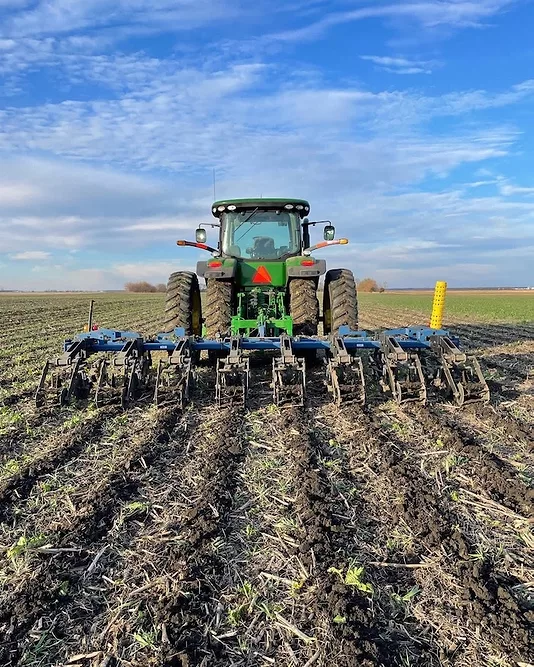
Wes Arsenault:So the big reason we started looking at strip till was in 2019, I think everybody remembers that was a real wet spring. We were fully conventional till and we had a couple neighbors that had been strip tilling for a few years and they were the only guys who could get in the field to plant in a timely fashion. So we're like, all right, what's going on here? We were out there with the field cultivator, dragging it through the mud, just couldn't get through the field. We thought, what are we doing here? We got to make a change. So after that we found a eight row blue jet strip to bar on a local auction and we're like, you know what? Let's buy it. It's cheap. We'll try it out, see what happens. Next year we strip tilled, oh I don't know, a few hundred acres and just kind of a trial run. See what happens.
Planting conditions were beautiful. We loved it. We kind of went into it, not really with a goal, we just were like, this is working for some neighbors, let's try and see what happens. And we immediately started seeing some of the benefits. The huge one for us is the labor savings. It's just me and dad. So in the spring we got all our strips built in the fall and he can go out and plant corn. I can run the sprayer and plant beans and two-man show, we can knock it all out. You don't have to have somebody field cultivators and staying ahead of the planter and all that stuff. That was the big one. And a lot of our ground is poorly drained. We're pretty low. We're right up against the main drainage dish, so we're about as low as it gets and it'll actually back in and flood our ground and we have to pump it out sometimes if we get too much rain, water table's really high.
So when we would go out there and chisel it, you chisel it, whatever, 12, 14 inches deep, you come back in the spring and you really got to wait till it's [inaudible 00:03:25]. Otherwise, you're just going to be sinking as deep as you till it. So just being able to get on those strips and in between the strips, holds the planter up, the grounds more firm. We can get out two, three weeks earlier than we could before on some of this poorly drained ground. And that was another one of those Unexpected outcomes of we weren't really expecting to see that. It was just, we tried it and that's what we noticed. So ever since then we've been, and full steam ahead with strip till we love it.
Noah Newman:Wow, it's working really well for you, it sounds like.
Wes Arsenault:Right.
Noah Newman:So, and you decided you wanted to give it a try. How valuable was the insights that you got from your neighbors? Were they really helpful for you guys or?
Wes Arsenault:Yeah, the one neighbor, I think he just started it, 2019 might've been his first year and he was just kind of experimenting with it too. And we didn't really know. I don't think he knew much about it at the time and we just saw how wet the spring was and we're like, he's the only guy who can plant corn in May, so why don't we try that? So that was the big thing for us. We saw it worked for him and wanted to try it.
Noah Newman:And was it a big challenge going from conventional to strip till? Or did you find that it was a pretty smooth transition in that first year?
Wes Arsenault:I would say logistically it was pretty smooth because you make your strips in the fall just like you would be chisel plowing in the fall. So I mean as far as getting the work done, it's about the same. The mindset for me was a little bit more of a challenge. I mean, my mind was made up from the beginning. I thought this is going to work, I know it's going to work, but at the time my grandpa was still around and he was farming with us and it took him a while to come around to it. Dad was a little skeptical at the time and just once we started doing it a few years and saw the benefits of being able to get out there earlier, we saw some yield increases, then I think everybody got on board.
Noah Newman:Yeah, that's awesome. So are you guys still using that blue jet machine?
Wes Arsenault:So we used that up until the fall, I guess up until last fall. We ended up buying a Gladiator with a Montag DryBox on it. We bought it with a neighbor, so we run that now. Up until then we were just making strips, spreading fertilizer ahead of the strip till bar, and this will be our first crop that we harvest with putting fertilizer in the strips. So we got our gladiator now.
Noah Newman:How's it looking so far here? Growing season going pretty well in 2025?
Wes Arsenault:Yeah, it's looking pretty good. I'd say yeah, we're probably a month out from picking any corn, but looking pretty good. I think putting that fertilizer in the strip helps out a lot, especially with the way these fertilizer prices are anymore, we were able to kind of dial it back a little bit, be more efficient, and I think we're seeing the benefits of it now.
Noah Newman:Yeah. Let's dive into your system a little bit. So let's go through the process. So in the fall when you're making your strips, when are you trying to make your strips? How deep are you making them and what are you applying and how much?
Wes Arsenault:I guess our objective is to try to get the beans out first and then we can put somebody in the strip till bar, which is usually me, and we can start doing some strips before we get done with harvest. Because you never know when the weather's going to change. So I mean we've run all the way through December before, just whenever it's fit and whenever you have time. But we do a variable rate mix of potash and DAP and we kind of go off of a removal rate from, I guess... I'm still kind of dialing in the fertilizer aspect.
What I did last year is I looked at the removal from the soybeans that we were applying the fertilizer into. I felt like that kind of gave me a good baseline to start off of still trying to figure out how I want to go about that because soil tests can vary and you might need phosphorus here where you don't really need the potassium or vice versa. So just having one tank is kind of a challenge to try and figure out a good system, but we're working through that. But if we can get those strips built in the fall, they weather through the winter and they plant really good in the spring it seems like.
Noah Newman:All right, let's burn a quick time out. And here's a message about environmental tillage systems, Soil Warriors. Soil Warrior systems help you defend your land and improve soil quality with a choice of durable models, features and accessories. Your soil Warrior helps you minimize erosion while creating precise nutrient-rich zones. Let us help you defend your land and improve soil quality. Check out soil Warrior systems online or request a demo today at soilwarrior.com. That's soilwarrior.com. Now back to the conversation.
.So then spring around and what are you doing? Are you doing anything else with the strips? Are you adding anything more with the planner nutrient wise or what's your... For the spring?
Wes Arsenault:So we plant right in the stale strips. We run two by two by two with some 28% nitrogen. Run about 30 pounds with the planter and then also starter in furrow and then we come back and wide drop the rest at V5, V8 whenever we get time, get rolling around to that.
Noah Newman:Got you. And then what else is in your starter fertilizer mix?
Wes Arsenault:We had been running a 10-18-4 with a pint of zinc, and I think this year we switched it back to just a 10-34-0 because of cost and some of our sandier soils, they stay colder longer and it seems to really pay to have that starter right there ready to go for it.
Noah Newman:And then for the wide drops, how are you determining rates and then do you have your own sprayer or side dress applicator or how does that work?
Wes Arsenault:So we have a Rogator and we're set up with easy drops and I kind of make a yield goal for each farm and I go off of that. So we just variable rate off of however many years of yield maps that I have, kind of make a map based off of that and variable rate according to that. So try to get up to my yield goal.
Noah Newman:Sounds like you have a good system in place, you have a well-oiled machine right now, and you had mentioned how strip till impacted your yields, so how much have they increased your yields and have you reached personal record yields with strip till?
Wes Arsenault:Yeah, so we've been very fortunate the past three years have been three record crops in a row. 2022 was a record, we beat it in 23 and then we beat it again in 24. So I was very happy with that. I would say our yields from when we started, we were sub 200 on corn on average we were in that 180 range and now we're getting up above that quite a bit. So I'm very, very happy with it, just being able to dial in and focus on what do these acres need in specific areas. We're doing some variable rate population now and if you treat every acre the same, you're going to get an average, but if you can bump up those better areas of the farm that pays dividends.
Noah Newman:Now what's your rotation look like? Are you no tilling soybeans and then strip tilling corn or what do you got there?
Wes Arsenault:So we no till soybeans most of, well, so most of... I guess all of my acres are corn, soybean rotation and then my dad's got some corn on, corn on a little bit sandier stuff. Yeah, no till soybeans. Also doing some cover crops with that and then we come back and strip till into the bean stubble to plant corn. And then the corn on corn, we're still trying to figure that system out. In the past we had just been chiseling the corn on corn because we couldn't get our blue Jet strip till bar to go through the corn stalks. It just didn't have enough clearance and we got that Gladiator and we were having the same issues with it. We couldn't get it to go through in the fall. So this year we strip tilled the corn on corn in the spring and that seemed to work a lot better. So still trying to figure out a system for the corn on corn I guess.
Noah Newman:Yeah, learning something new every year. Now what kind of cover crops are you planning?
Wes Arsenault:I'm enrolled in a Equip and a CSP program, so we're doing just plain cereal rye, head of beans, and then the corn, I haven't done a whole lot yet. My CSP contract, I'm doing a mix of, this will actually be the first year for it. But I'm doing a mix of rye, winter barley, camelina and crimson clover. So we're going to do that on about 80 acres and see how that works out.
Noah Newman:And are you drilling that in?
Wes Arsenault:I think I'm going to going to borrow a neighbor's VT tool with a cover crop seeder on it for this first year and see how that goes.
Noah Newman:Nice. And what are you hoping to see as the top benefits from the cover crops? Are those just helping you with erosion control, moisture retention or?
Wes Arsenault:Yeah, well like I said, a lot of our stuff's poorly drained and the stuff that we rent, we can't put tile in it. So I think the combination of no till and cover crops has improved our drainage immensely. I have one farm in particular, I kind of treated as my test farm, but it's been a hundred percent no till and cover crops for eight years now and it's got spots on that farm where you'd get an inch rain and there'd be a pond. Well that just doesn't happen anymore. You get a big rain and water comes up and next time you drive by it's gone. So I mean, yeah, that's something you can visibly see as a benefit.
Noah Newman:Yeah, a couple of weeks ago here, and we're in the Milwaukee Wisconsin area, and a couple of weeks ago we got over a foot of rain in some areas and one day it was crazy.
Wes Arsenault:Wow. Yeah.
Noah Newman:And I think it's safe to say the no tillers and strip tillers were a in little bit better shaped than the conventional guys.
Wes Arsenault:Yeah, for sure. Yeah, we had a big rain this spring. It was like three and a half inches and it came down pretty quick. And like I was saying, this ground up around the home farm's pretty low. We had to pump a lot of it out and having it all strip till, no till, the water seemed to go away quicker so we didn't have any holes.
Noah Newman:Now what would you say to some farmers who might be on the fence about switching their system up or implementing strip till? What kind of advice do you have to people who are hesitant?
Wes Arsenault:The big thing with me is you're always going to have those neighbors that question you on it and if it's something you want to try, just go for it. Like I said, I wasn't very skeptical in the beginning, but the older generations above me, they had their doubts, but if it's something you really want to try, just go do it on a few acres. When we started, I didn't know what we were trying to accomplish by it other than I saw the neighbor who was able to plant and we weren't. So that was my main goal. In that first year we saw benefits that we didn't even expect better drainage we could get on there quicker, the cost savings and labor, the cost savings and fuel, they just all started adding up.
Noah Newman:And it sounds like you had a good game plan going in with the neighbor to get the Kuhn Krause Gladiator.
Wes Arsenault:Yeah, that works out really good. He actually likes making his trips in the spring, so I get it all fall. I don't have to worry about actually sharing it in season and then when we're done we drop it off at his place and he uses it in the spring.
Noah Newman:See that's very interesting because you always hear the debate about when's better to make strips fall or spring and it sounds like you could really make it work in either season.
Wes Arsenault:Right, yeah. So like I was saying earlier, our ground is pretty sandy up here and it's also very variable, but our farm is, we got some black sand, a little bit of yellow sand on some hills and then you go a mile north where his farm's at and it's completely yellow sand, white sand.
Noah Newman:Wow.
Wes Arsenault:So he doesn't want to make his trips in the fall because he is afraid it's just going to blow away. So he'd rather put it in the spring and he can irrigate it and keep it from blowing.
Noah Newman:Anything new that you tried this year or looking to maybe try in the near future?
Wes Arsenault:I guess it's not really this year our cereal rye ahead of beans 2024, we had a real cold spring and I was worried that if I sprayed the rye it just wasn't going to die because it wasn't actively growing. So we just let it grow and it was kind of purely by accident that we ended up planting green. And the rye, it was headed out, it was as tall as me and I'm like, everybody else does this and it works, let's just try it and see what happens. So I ended up planting a couple of hundred acres into green rye and I was pretty terrified until about July when you could actually see the beans poking through and they came up beautiful. And we had a lot better weed control on those farms where we had that rye. So that's something new that we've been doing. I ended up doing the same thing again this year. I just let the rye grow, planted it and beans came up through it. They look beautiful.
Noah Newman:That's interesting how that works out.
Wes Arsenault:A lot of the ground in this area, like I said, is poorly drained and that was one of the big factors that was kind of against me in the beginning because I had a mindset of, oh, if you want a no till, if you want to strip till, you got to have good drainage. That's what everyone was telling me. You got to have good drainage, you got to have good drainage. Well we tried it and it ended up giving us better drainage just by doing these practices. So you don't have to have the perfect farm, you don't have to farm in 300 bushel corn territory to make this stuff work. It actually seems like it will help you out better in the marginal stuff. So that's one thing that I learned early on and if that could push somebody else into trying it, I think it'd be great for them.
Noah Newman:All right, that'll wrap things up for this edition of the Strip Till Farmer Podcast. Big thanks to Wes for taking some time out of his busy day to join us for that conversation. Also, thanks to our sponsor Environmental Tillage Systems for making this podcast series possible. You can listen to previous episodes at striptillfarmer.com. All right, thanks so much for tuning in. Hope you have a great day. We'll see you next time.