
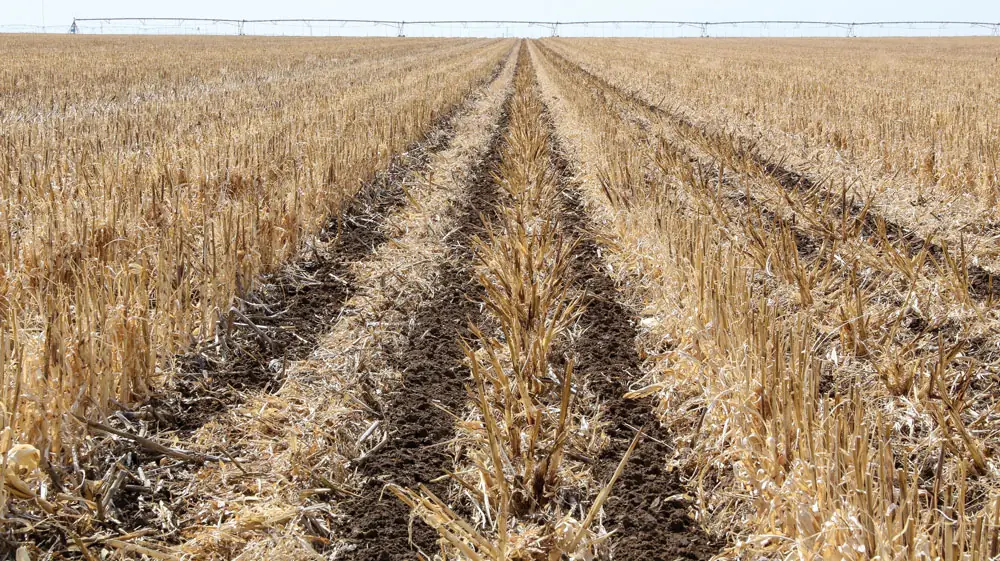
Harvest is underway across Iowa, and one of the biggest surprises this season may not be on the yield monitor. It is at the fuel pump. Diesel prices have increased sharply ahead of the 2026 harvest season, substantially increasing operating costs, making every tillage pass more expensive than budgeted for last winter. Harvest fuel costs are unavoidable; however, you may not need as much fall (or spring) tillage as you think to prepare for the 2027 growing season.
With fuel costs high and margins tight, this fall may be a good time to reevaluate whether every tillage pass is necessary. For many Iowa corn-soybean rotations, reduced tillage systems such as no-till soybean or strip-till corn can lower fuel expenses without sacrificing productivity.
High Fuel Costs Put Tillage Under the Microscope
Each tillage pass carries direct costs through fuel consumption, labor, machinery wear, and depreciation. Iowa State University's (ISU) Ag Decision Maker cost of production identifies fuel, repairs, and machinery ownership costs as significant components of crop production expenses. Reducing field operations is one of the few immediate opportunities to lower production costs without or with only minimal effect on seed, fertilizer, or chemical costs.
No-Till Soybean: Proven Ways to Reduce Expenses
While, for some farmers in parts of Iowa, tillage has long been viewed as a standard fall practice, current fuel prices provide a strong reason to question whether the benefits of each pass justify the expense. Soybean acres following corn are often excellent candidates for no-tillage or reduced till systems. ISU research has consistently shown that soybean is highly adaptable to reduced tillage and no-till systems, with little or no yield penalty in many environments when stands are established successfully. Making sure the planter is properly set up to get the desired planting depth and furrow closure are the two most important steps to ensuring adequate soybean emergence and plant populations.
Beyond fuel savings, reducing or eliminating fall tillage can improve operational efficiency by allowing more acres to be covered in less time during the often-short window between harvest and winter.
Don't Ignore Compaction After a Wet Harvest
Fuel savings should not be the only factor influencing tillage decisions this fall. Harvest conditions matter. If combines, grain carts, and trucks are operating on wet soils, compaction risk increases significantly.
Before scheduling tillage, assess whether actual compaction problems exist. Deep ruts and severe compaction zones may require corrective action. However, rut repair and compaction management are not always the same thing. Shallow surface ruts can often be addressed with minimal soil disturbance, while severe subsurface compaction may require a more targeted and aggressive approach.
Tillage conducted under wet soil conditions causes smearing and structural damage while consuming expensive fuel. With water-logged soils in much of Iowa this fall, deep tillage will have little or no positive effect on compaction problems, and may even make problems worse. In many fields, especially harvested under favorable conditions, leaving residue undisturbed ahead of soybean may be the more economical and agronomically sound decision.
As harvest continues, take a fresh look at your tillage plans. High fuel prices make every field pass more expensive than it was just a few months ago. For many, one of the easiest ways to reduce machinery costs this fall may be to eliminate tillage for next year’s soybean crop. When fuel prices rise, the cheapest tillage pass is often the one you do not make.
Examples
Variable cost savings from three examples are shown in Table 1. It is assumed that savings would be in equipment variable costs, with no changes to the equipment line-up and the current planter set-up is capable of no- till soybean planting. Simply eliminating unnecessary tillage can result in significant direct savings without considering soil compaction that tillage itself may cause under wet fall conditions as we have in much of Iowa.
| Variable Cost Change | Additional Fuel Cost Change* | Labor Cost Change | Variable Machinery Cost Savings | |
| Option A: Move from tillage to no-till | ||||
| Remove fall tillage (Subsoiler / V- Ripper) |
-$10.70 |
-$4.44 |
-$2.86 |
-$18.00 |
| Remove spring tillage (Field Cultivator) |
-3.80 |
-1.70 |
-1.02 |
-6.52 |
| Variable cost reduction |
-$24.52 |
|||
| Option B: Remove fall tillage but retain spring tillage pass | ||||
| Remove fall tillage (Subsoiler / V- Ripper) |
-$10.70 |
-$4.44 |
-$2.86 |
-$18.00 |
| Retain spring tillage (Field Cultivator) |
1.70 |
1.70 |
||
| Variable cost reduction |
-$16.30 |
|||
| Option C: Remove fall tillage but add in a residue management pass in spring | ||||
| Remove fall tillage (Subsoiler / V- Ripper) |
-$10.70 |
-$4.44 |
-$2.86 |
-$18.00 |
| Add in residue management pass (Tandem Disk) |
4.90 |
1.17 |
1.43 |
7.50 |
| Retain spring tillage (Field Cultivator) |
1.70 |
1.70 |
||
| Variable cost reduction (assuming field cultivator pass remains) |
-$8.80 |
|||
*Variable costs from AgDM A1-20 use a fuel price of $2.89 per gallon, fuel cost column shows additional fuel savings assuming $5.50 per gallon fuel price ($2.61 per gallon increase), per AMS 2863 for September 2026.
Labor savings uses a wage rate of $20.40 per hour.