
Brought to you by:

On this edition of the Strip-Till Farmer podcast, brought to you by Environmental Tillage Systems, Understanding Ag consultant Brian Dougherty gets to the root of compaction.
Every equipment pass risks soil compaction, a problem that affects root and crop growth, water infiltration, crop fertility access and your bottom line. But many management practices exist to help fix compaction and avoid it in the future.
Dougherty, who grew up on a dairy farm in Waukon, Iowa, examines what causes compaction, how to assess and remediate compacted fields and prevent compaction from stealing your strip-till profits.
Dougherty explains how to solve compaction issues with cover crops, discusses the role that well-aggregated soil plays in improving trafficability and shares tips for managing wheel traffic to minimize the effects of compaction on yields.
|
|




The Strip-Till Farmer podcast is brought to you by Environmental Tillage Systems.
SoilWarrior® systems help you defend your land and improve soil quality. With a choice of durable models, features and accessories, your SoilWarrior helps you minimize erosion while creating precise, nutrient-rich zones.
Let us help you defend your land and improve soil quality. Check out SoilWarrior systems online or request a demo today at www.soilwarrior.com.
Full Transcript
Noah Newman:Hey, great to have you with us for another edition of the Strip-Till Farmer Podcast. I'm your host technology editor, Noah Newman. Big thanks as always to our sponsor, Environmental Tillage Systems, for making this podcast series possible, and today understanding ag consultant Brian Dougherty is going to get to the root of compaction.
Dougherty, who grew up on a dairy farm in Waukon, Iowa, examines what causes compaction, how to assess and remediate compacted fields and prevent compaction from stealing your strip-till profits. A lot of interesting stuff, jam-packed session here from the 2024 National Strip-tillage conference, wall-to-wall information. Let's jump right in.
Brian Dougherty:Compaction, so I broke this into four different parts. Is this mic too loud or are we good? We're good.
All right, so we're going to talk about what causes it, some different ways we can assess compaction in the field and then how do we fix it, what do we do about it, and then how do we prevent it from happening in the first place. So, we'll start out with causes, what causes compaction.
So why soils get compacted. I've broke it into three different basically categories here. If you think about your soil health, we got physical, chemical, and biological. So our biological factors, basically, to me that's a lack of soil aggregation.
I'm going to talk about aggregation a lot. I'm going to beat you over the head with it. So, I think that's the foundation we need to build on. Chemical factors, poor soil structure, that could be some nutrient imbalance or excessive application of something. We'll get into that. And then your physical factors, damage to soil structure, I'm going to get into tire pressure and we'll talk tracks versus tires and axle loads and all that kind of stuff, traffic management.
So it is really just how I think about some of the challenges. So what is compaction? What's actually happening in the field?
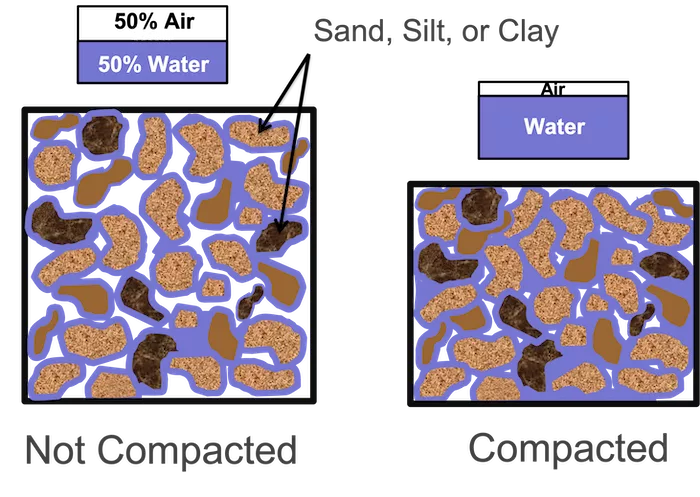
So we just think about soil. We got mineral, we got air, we got water, three components. Well two of these, minerals and water, are incompressible in engineering terms. The only thing you can mush down here, if you put a load on that soil, is your airspace, your pore space.
So if it's completely full of water, actually you can't compact soil technically. We'll get into that. So this is the challenge, and we need our soil to be able to breathe. We need good gas exchange in our soil. So when we've got compaction, we're losing our airspace.
So symptoms, I'm not going to go through these. You all know what they are, poor nutrient cycling, lost yields, on down the line. There's a whole laundry list of things that can go wrong when your soil is compacted. Some of these are pretty easy to see. Some of them a little bit less so in the field.
But the point I like to make with compaction is it is not natural. In a natural system, soils aren't really compacted unless you just had a hurricane or something like that. To me, compaction is really a symptom, and it tells me that there's something wrong with your soil if it's compacted, whether that was induced by management or whatever.
And the question then is what actually causes poor soil function? So compaction just a symptom. So we had an need to deal. If you're going to deal with your compaction in the long run, we need to address this. What is it that is not allowing your soil to function properly?
Again, three simple categories I break it down into. You either got too much equipment, not enough biology, or probably some excessive nutrient application, that, these right here, are the causes of most dysfunctional soil, I would call it, in our modern cropping systems.
So I talked about aggregates. How many people have soil that looks like this? Anybody? Show of hands, I'm impressed if you got that many that have soil that looks like that. A lot of people do not. I travel all over the country with this job. I never see this. I shouldn't say never. I see it in pastures. Rarely see this in crop fields.
This is a well aggregated soil. So those aggregates are just chunks of soil essentially glued together by biological activity, and this is how we get our air and this is how we get our water into the soil. It's all those interconnected pore spaces. That's what we need.
But what often isn't talked about is these aggregates are constantly being formed and consumed by biology in the soil. They break down every four weeks or so. So if you're going longer than four weeks without a living root in your field, you're losing aggregation. How many people have gaps in their year or you got more than four weeks without a living root? Pretty much everybody probably, so that's a challenge we need to overcome.
So just simple analogy, I use Jenga blocks. Just pretend these are your aggregates. We got a weak soil here. We don't have the glues to hold them together. You add a disturbance. What happens? Your tower falls over.
This is just your soil collapsing through disturbance if you don't have the biological glues. But if we take that same soil and we glue it together, in the case of soil, we're going to use biology here. I'm going to throw some Elmer's glue on there. Now we disturb it so can hold up. It's really that simple. We're just trying to add more biological glue to the soil to create aggregate strength so we can withstand compaction.
So why do living roots matter? Some of the earlier speakers today touched on some of this. What those plants are doing is they're carbon essentially, sugars, carbohydrates, through photosynthesis. They're pumping some of that out through the root system into the soil, root exudates. That feed your bugs.
Carbon, that's your food source. They do that for a reason. That's because they're going to get nutrients in exchange and water, in the case of mycorrhizal fungi. So they're doing this for a reason. You've also got your microbes doing their thing, living and dying and eating and puking and killing each other in the soil, and that produces... The fancy term is extracellular polymeric substances. I like to just say dead microbe goo. It's a lot easier to remember.
That also helps glue your soil together. Mycorrhizal fungi, incredibly important, those are the good guys that tap into your plant roots. Bring it nutrients and water. They produce this strong protein, very sticky, called glomalin.
I've heard estimates up to 40% of your organic matter is actually glomalin. That is a key right there for gluing your soil together and providing strength to withstand compaction. And if you've got a lot of disturbance, you probably don't have very many mycorrhizal fungi.
We run lots and lots of biological soil tests and we look at these numbers, a lot of fields are very lacking. So it's really simple. No plants, no glue, no aggregates. Living roots are absolutely fundamental if you want to be able to withstand compaction in the long run and to get rid of compaction.
Bare soil, I call this management induced compaction right here, crusting. That's because you do not have any surface armor and you get this. We get hit by a raindrop, no big deal. You're a little tiny little ped of soil. You're a microbe, you get hit by that raindrop. That's like a grenade going off. It blows up your world.
So we've got to armor that soil so we don't end up with this. And when that happens, now that's going to sit there and bake in the sun. We check soil temps. We regularly see soil temps, 130, 140 degrees. You're just cooking the life right out of your soil at that point.
Over fertilization, a lot of people probably would argue about this. Some of you might throw some stuff at me here. What happens when you over fertilize? Well, too much nitrogen especially is a culprit here. But remember the plant's pumping these exudates out for a reason, and that's to get nutrients in exchange.
Well, if you just put a whole bunch of nutrients right in the root zone, the plant's going to say, "Well, I'll just use that. I don't have to feed the biology. I'll just take the nutrients up directly." So what does it do? Well, it stops pumping out as many exudates.
Well, what's the problem with that? We need those exudates. They're part of the whole system for building soil aggregates, slows down your microbes, lack of carbon. Then what happens? You give those microbes all the nitrogen they need, they go looking for carbon, because they've got the nitrogen. So there's a balance there. They're going to go looking for more carbon to offset that nitrogen.
So what do they do? They eat those glues. That's a carbon source. So you're basically over fertilizing your way into collapsing your soil, and that's a real phenomenon. We see that happening.
So those are some of the issues there. So now I'm just going to get into how do we assess compaction out in the field? And this is really pretty darn basic stuff. Not going to get into detail on yield maps and all that, but you can often pick some of these things out. You can just visually see them in the field. You can use a penetrometer.
We do a lot of visual assessment, slake test, slump test. How many of you have seen these? How many people just never raise their hand when somebody asks if you've seen it? That's what I thought. Everybody raised their hand.
So, this is not a measure of compaction per se. It's an indicator of how well aggregated your soil is, which is how you deal with compaction. So, it's a good tool. We love to do infiltration tests.
Here's one I did in Nebraska. Silage ground had been super dry, pounded the ring in, where there was no wheel traffic. It took two inches of water in 12 minutes. That's actually really good on a tilled soil, but it was a dry year. That soil hadn't collapsed yet.
Moved over 30 inches in the wheel track, took about a half inch and just stopped. I would've been there all day trying to get any more water in that soil. Tipped that ring over. What happened? Just completely turned the sludge. That soil just completely collapsed, because it had no aggregate strength.
So these are handy little tool. Just dump an inch of water in a ring and time it. See how long it takes to get that water in the ground.
Shovel test, dig a hole. They talked about that this morning. We see lots of this. You see this horizontal fracturing that's dead giveaway you got a compacted layer there. You got a hard pan, you got a change in density. A little hard to see here, but all his roots are going straight sideways.
That's one of the first things you want to look for when you dig a hole. Look at your roots. They should be going down, not straight out. So super easy stuff to do, easy things to look for.
The challenge with this, and you see all these little horizontal fractures, is water's kind of funny when it moves through soil. So it'll move down until it hits this and then it'll stop. If there's a density change, if there's a change in texture, that water will just stop until everything above it is completely saturated, and only then will it keep moving, so it slows down your water infiltration.
So, here's just a series of pictures. I'll confess these were taken on our farm in Northeast Iowa, dairy farm. So I just like to show this. It's almost like a time series of how you can wreck your soil. I blame this on my brother. He was running the farm when I did these.
But always try to find a reference area, fence line, buffer strip, the edge of the woods, go to the road ditch if you have to, and just see what that soil looks like where it hasn't been disturbed. That's that chocolate cake look, cottage cheese look we're looking for, alfalfa. It's looked pretty good. Not as good as here. But we got some worms, looking pretty good.
Get into corn silage, starting to see some crusting there. Tilled corn for grain, now it's starting to look pretty bad. Tilled corn silage, looking really bad. Now here where it had extra traffic, that soil's just completely destroyed. There's no aggregation left there. That is a brick. You all get zero water infiltrated into that.
The interesting thing about all of these pictures, they were all taken on the same day. Same soil type, same farm, all within about 500 feet of each other. This is all management. Management caused it and different management can fix it. It doesn't have to look like that. We're going to talk about some ways to do it.
So how do we fix it? We find an issue. What do we do? We preach ad nauseam about the soil health principles. That's essentially what our company does. We teach the soil health principles and we help farmers implement them.
We've got to keep the soil armored. We've got to keep a living root in the soil for a whole bunch of reasons. It protects that surface from the wind and water impact. It builds aggregates. It feeds your biology, it adds organic matter. It reduces your bulk density. It improves your water infiltration, all of those things.
So if you're, say, a corn-bean producer and you don't have any cover crops in your rotation, you're going to fight compaction forever. Sorry. It's just the way it is, because you don't have enough living roots out there to build aggregates, and aggregates are how you withstand compaction.
Use diversity as a tool. Now, this is tough in a corn-bean rotation. I get it. It's hard to get anything other than cereal rye in this part of the world to overwinter. But think about can you get a small grain in the rotation or something like that, so you got an opportunity to get some of these other species in.
Your fibers rooted, cereal rye, annual ryegrass is fantastic for breaking up compaction. A lot of people don't like it, because it can be hard to kill. Use some of your brassicas, your forbs, for deeper taproots. Having one species is infinitely better than no species, but many is better than one in our book. So, use that to your advantage.
Speaker 3:[inaudible 00:14:24] did you say mix?
Brian Dougherty:Yep. Yeah, diverse mix. No, multiple species together ideally. They work synergistically. Around here, probably our best tool right now would be winter camelina. If you want something overwinter like other than rye, it's something that's not a grass.
It's called winter camelina. It's a newer cover crop. It's a brassica that reliably, pretty reliably, over winters here. Doesn't put on much growth at all in the fall. If you let it go in the spring, it'll bolt. Nothing's perfect, but it's at least some diversity you can get out there.
You can do radishes, turnips, things like that in the fall, but you got to get them out. In this part of the world, probably mid-August versus September if you're going to get any growth on them, because they're going to winter kill. It's pretty easy to kill. You just hit it with glyphosate. Same thing you're terminating the rye with. You should be able to take it out.
But it's a tiny, tiny little seed, so it's tough to fly it under the plane because it might end up in the next county. You could probably do it with a drone, but drilling it would probably be best. So yep, you can mix it right with the rye and just drill them together.
Can't really talk about compaction and aggregation without talking about calcium in particular. You can hear a lot about that, I'm sure. Soil texture and mineralogy, it is important. There's a lot of high magnesium soils out there. They're just harder to work with.
Magnesium makes your soil tighter. This isn't 100% rule of iron clad rule, but high potassium, high mag, those soils tend to be more challenging to work with. Calcium, it's like the Goldilocks mineral. It holds your clay particles at just the right distance apart with just the right strength, where it stabilizes it, it helps... We just call it flocculation. It helps your soil stick together. Whereas magnesium tends to all out to collapse. Same with potassium.
So there's been argument for decades and decades and decades about soil balancing the Albrecht numbers and what they should be, just roughly 60 to 70. If you look at your base saturation on a soil test, some people say 75. Depends on whether it's a sand or a clay, but this stuff matters. It is important. There's been some research on it that says, "Yes, you get that ratio where it should be. You bring your calcium up, you can help with some of these soil structure issues."
Now, having said that, especially if you're renting a farm and let's say your base saturation is 40% calcium and you need some high calcium lime, well, you're going to have to do the math on it and see what is it going to cost you to buy that to bring that number up, and is it worth it. If you own the ground, I think it's a good strategy. Do it slowly over time.
Monitor your soil test because calcium can take multiple years to break down, become available in the soil so you don't want to overshoot. So it can be a good strategy. And Gary could get up here and talk for three hours about all this stuff, and I'm going to leave it at that.
Let's say your soil is compacted. How long is it going to take you to get rid of it? Well, that's an "it depends" question. This is a nice little chart from Penn State, looking at yield years after compaction.
Good news and bad news, so topsoil compaction, bad news is it hurts your yield a lot. Good news is you can get rid of it quicker. Subsoil compaction, good news, it doesn't hurt your yield as much. Bad news is it takes a lot longer to get rid of it.
And if you're compacting really deep, we're going to get into axle loads and how that happens. It can be everybody in this room would be dead before you get rid of something that's compacted three feet deep, it can be almost permanent. So I like to think of it as the old diamonds are forever commercials.
You guys remember those? There's probably about two months salary worth of corn in that grain cart to pay that driver's salary, but that compaction he's creating out there is going to last a lifetime. You guys are supposed to laugh at my jokes here. Come on.
Freeze-thaw, that's another question we get a lot. Well, can't I just let the soil freeze-thaw? Won't that just take care of the problem for me? Kind of, sort of, probably not. It only really helps near the surface and you got to have to.
So, what actually causes that heaving effect, that freeze-thaw effect, is just the water and the soil freezing and expanding. So if you go into a dry winter like we had last year, there's not much moisture in the soil. You're going to get very little freeze-thaw effect even if the temperature fluctuations are there, because you got to have temperature fluctuations and the water.
And then think about it. Say your compaction a foot deep, how often does it freeze below a foot and then come back up again and then down again and then up again? Not very many, once or twice during the winter, maybe. Right at the surface, it'll happen more often, but this is not going to get rid of your deep compaction and it's not a reliable way to get rid of compaction.
So how about ruts? That's another big challenge. It happens. Sometimes it's super wet and you got to go. Well, it's better obviously to wait for things to dry out before you try to fill your ruts. And if you do, just thinking about it, you go out there and you think, well, I have to till deeper than that rut to fix the problem, right?
Well, that's actually the opposite of what you want to do because look at that rut right there. What is that holding? Water. The bottom of that rut is going to be wet for weeks and weeks after that top dries out. So if you go in and till deeper than that rut, now you're just tilling a bunch of wet soil and you're going to smear it again and you're going to re-compact it, so do a shallow tillage.
The goal is to fill it in. The goal isn't to rip deeper than the rut trying to get rid of the compaction. And if it's really wet, you might have to do a real shallow tillage, just where it's dry on top and then come in with a second pass. Try to only do this where you have to. This is not the time you want to try to fix your deep compaction with a deep ripper or something like that. You're probably going to do more harm than good.
Wet spots, anybody seen one of these this year? What do you do with them? Well, I would encourage, if it's accessible, which a lot of them, I get it, they're out in the middle of a quarter section or whatever and there's no way to get to it. But if you can get to it, I would encourage you to just grow a cover crop on it whenever it dries out, whether that's in June or September or whenever it is.
I know some people will try to sneak in there and plant something before the insurance cutoff date so they can get a check. But if you really want to deal with this problem area longer term, again, you need living roots to do it. So, put a cover crop mix in there.
If it's late spring, you can do a nice diverse, warm season mix. If it gets later in the year, you can just do rye or trit, something like that. In the fall, you can even try to frost seed into these in the spring. There's lots of different ways to try to deal with that compaction with roots and get this area somewhat healed, build some aggregates and get it to drain better. You'd be amazed at how much more productive that will be the following years if you just give it a year of rest and put a cover crop in there.
So tile's obviously a good tool and these really wet areas. Prairie Pothole, Northern Iowa, Minnesota, I won't get too much... We can talk all day about tile. I used to be an engineer at Iowa State and dealt a lot with tile, but I mean that certainly can help. It's just trade off. Do you want to spend the money?
If your water table's naturally a foot from the surface, I mean, yeah, you're probably going to need some tile to farm it. Gary?
Speaker 4:[inaudible 00:22:46]
Brian Dougherty:It'd help, but I'd use diversity. I mean I wouldn't do just radishes. A single species of anything can be a benefit, but radishes, they often don't do as much for compaction as people think they're going to. I mean, they help, but then you got to see your radishes out there and they're all going to die and decompose and stink.
And if you got nematode issues, that's a good way. That's an organic tool. For dealing with nematodes, you do a straight crop of brassica. But I would do a mix. I would get some fibrous roots in there, because you got all that water sitting there.
That surface is crusted and compacted. You need some fibrous roots on the surface to deal with that. So get some sorghum sedan or Japanese millet can tolerate wet conditions. That's a really good option for those wet spots. Just use a diverse mix.
Deep tillage, now I'll start getting somebody to throw some stuff at me. The research on it, look at what the universities have done, trials that have been run by different organizations. It really only gives you a yield benefit about a quarter of the time. About half the time, it doesn't do anything, and about half the time, it actually makes it worse.
So, do a little back of the envelope end math on that. How often are you making money doing deep tillage? Well, you already got a three in four chance of losing money, because even here you still got to pay for that tillage pass. So, did you get enough yield benefit to do it?
So, I'm a hard no on these kind of tools, if you're going to do it needs to be dry and you need to be able to identify exactly where your compacted layer is. That's where you get out your penetrometer or you dig a hole or whatever and make sure you're getting under it. Otherwise, you're wasting your money.
Now, I am guilty as charged. I ran one of these things for years, and man, it feels good out there making that tractor snort, pulling up big slabs of soil, front end coming off the ground, me turning around the end rows. I mean, I felt like I was doing something, but I realized all I was really doing is wrecking our soil and burning up diesel fuel.
These are definitely a better tool. The straight shank, the para-tills or whatever you want to call them, they just lift the soil. They're not completely inverting it. What I've seen with these is that soil will roll up the front of the shank. I've dug soil pits and found big old chunks of clay subsoil mixed in with the topsoil after you run one of these things.
So, not something we necessarily want to be doing. Where after this, minimal surface disturbance, just deal with the compaction. We don't want it looking like this where it looks like you're basically out there with the chisel plow.
This is an idea I really like. I've never actually seen one of these in the United States. I had to steal these pictures off the internet, because I don't know anybody that has one. But basically what they're doing here, these are rippers, but they've outfitted them with either cedars or liquid application systems so they can drip some humic acid or compost extract or whatever right down the shank and/or seed something right on top of it.
Because if you're going to go out there and spend all that money and open up this slot in the soil and then go back to doing whatever you've been doing before, what's going to happen? You're going to close right back up again, and you're right back in the same problem the next year. So, we want to get roots down that channel ASAP.
If you're going to go out there with a ripper, get a cover crop on there, or if you happen to be ripping in the spring, most people are going to do it in the fall. Get a crop planted to that channel open and get some bang for your buck for spending all that fuel. So I like that idea, but again, if you want to do that, you're probably going to have to build one. I don't know anybody that makes one.
Noah Newman:All right, let's burn a quick time out. And here's a message about Environmental Tillage Systems' SoilWarriors. SoilWarrior Systems help you defend your land and improve soil quality. With a choice of durable models, features and accessories, your SoilWarrior helps you minimize erosion while creating precise nutrient-rich zones.
Let us help you defend your land and improve soil quality. Check out SoilWarrior Systems online or request a demo today at Soilwarrior.com. That's soilwarrior.com. Now, back to the conversation.
Brian Dougherty:You want some moisture? I would agree. You just don't want it to be too wet. That's the key because if it's too wet, you're going to smear it and you're just creating another compaction layer. And I'll get into what is too wet here in a little bit.
So a deep tillage versus cover crop, I mean, I'm going to vote cover crop every time. I mean, essentially what it comes down to is, yes, this will work temporarily, any kind of tillage, it'll give you an immediate change in soil structure, because you just did your tillage pass. It does increase water infiltration initially, very short term.
But in the long run, it makes it worse, and you got all these other problems. More erosion doesn't do anything for soil quality. I'm a fan of the long-term fix. Let's use living roots to deal with the problem rather than steel.
You cannot fix compaction in the long run with steel. You cannot build aggregates with steel. The only way to do it is with biology. Now is where you really get people riled up, get somebody throw something at me. So how many of you have heard this or said this yourself? "Gosh, dang it, I can't get my soil to warm up in the spring, so I got to go out there and till it." Whether that's strip-till or turn it over, whatever.
The way I view that. Now, within context here, this is just a symptom. Now, if you're in central Minnesota, you're not going to get your soil to warm up like somebody in Missouri. That's not what I'm saying. You're not going to make that kind of a difference.
But compared to your neighbor, you can fix this. Cold, wet soil is just a symptom of compaction, which is a symptom of poor soil function, which is a symptom of lack of aggregates. So think about air and water, which one takes more energy to warm up? Water.
So what do we need? We need pore space. We need air if you want to warm your soil up faster, how do you get air in your soil? You build aggregates. The solution, and a lot of people are figuring out now, whether you're no till, strip-till or whatever, is the living route.
A lot of people no-till for decades, and they just hit a plateau and things just didn't get better and sometimes started getting worse again. Once you put the living root in the equation, then you got a synergistic system, you got minimal disturbance and you got living roots working together.
Biological activity can actually help warm up your soil. I'm going to talk about some cover cropping strategies you can use with some winter kill stuff that can actually have a dark residue and actually warm up the soil for you. Aerated soils just warm up faster.
Bio strip-till. Has anybody tried this? How many of you have heard of this? So basically this is strip-till, but you're just using a living root to do it. Now in a northern climate, if you're in Minnesota, Northern Iowa, this is probably going to be tough to pull off.
But what they're doing here is they're just planting a strip of whatever... Let's just say it's rye. You're going to put in your strip or rye, and then every 30 inches you're going to leave a gap. But instead of leaving that bare or running a strip-till you're going to plant a cover crop in there, that's going to winter kill.
So you got to have equipment set up to seed two different species at the same time or make two passes. But then the idea with this is this is going to die out over winter. That residue is going to turn brown, and there's your strip-till system. You're just doing it with a living root.
So radishes, turnips, fava beans are a good one. They have a dark residue and then that will die and that will warm up that strip in the spring, and you're using living roots to build aggregates instead of doing tillage, and then you just come in and plant right into that. It's a pretty slick system.
But again, you got to be in a climate where you can get some growth on this or get it in early enough, late summer or fall, to really make this work. This would be a great option after a small grain. After corn to beans, it's going to be too late to get any growth out of that, so something to think about.
Prevention, how do we actually prevent the problem from happening in the first place? I'm going to get into a bunch of equipment stuff here, but first going to talk about moisture, how wet is too wet?
So have you heard of field capacity? Everybody heard that? So basically field capacity, that means your soil is holding all the water it can hold against gravity. So if you've got tile drainage and your tiles are running, you are beyond field capacity.
It might be a couple feet down the profile, but you're saturated at that point. This is what we call gravitational water. That's the stuff that goes out your tile line and away.
The worst compaction that you cause is actually right before you hit field capacity. And that seems kind of weird, but it's because water, it basically acts as a lubricant and allows these soil particles to move around. And what you don't have a whole lot of pore space left.
You got some, but this is where your worst compaction happens. It doesn't really happen here because this soil's all dried out. There's no lubrication there to allow that soil to slide past each other.
Now, here when it's completely saturated, it seems kind of bizarre, but the compaction is actually not as bad because remember, water is incompressible. Now you're going to go out and make a heck of a rut if you drive through that. But everybody's seen this and you make a rut, what happens? Soil goes up.
You look at the rut, the side of it's higher than the original field elevation. That's because it's mushing the soil out and up, because it can't compress it because it's full of water.
So, here's some nice charts. This is from the upper Midwest soil Compaction guy. This is a free download, just Google it. Fantastic publication, Jodi DeJong Hughes, who's given a talk right now. One of the authors, good resource, a couple of graphics out of that.
And basically what this is showing, so we've talked about those biological glues here. Basically the more glue you have, the more compaction you can withstand at wetter conditions. It's pretty simple. Over here, we're showing that same curve. Again, higher moisture, bulk density is just the measurement we're using or compaction.
The higher it is, the more you've compacted your soil, and right about here is where you do the most damage. And over here, it actually goes back down because the soil is completely saturated and you're just mushing water around at that point. So when you think the soil's... It's a little sticky and you're not really sure if you should be out there or not, you shouldn't be out there. That's how you know.
Now, some people are just going to do it anyway. I get it. You've got a lot of acres to get over or whatever, but just be aware that you're causing compaction and you're going to have to go back and do something about it. This is an awesome way to deal with compaction. Planting green, I talked about this morning.
Do your homework. We work with a lot of people doing this, but there's a lot of things you can screw up and you can hurt yield. But this is an awesome way, especially in wet conditions, because that root mass, especially from any kind of a grass, rye or trit or winter wheat or whatever, is fantastic for holding your equipment up, holding that soil together to prevent compaction, gives you something to drive on.
I've seen videos and pictures of people out planting in rainstorms. There's no mud on the tires because they're driving over all this green mass here. But again, do your homework before you go down that road so you don't screw a bunch of stuff up.
Biology, I talked about worms this morning. I'm going to reiterate the importance of worms. If you have compacted soil, this is your number one friend right here. You need to get some worms in there. How do you do that? Living roots, minimal disturbance.
The estimates are, and it depends on how many worms you have and how active they are and all that, but somewhere between five and 20 years, if you've got a decent worm population, they will turn over the entire top six inches of your soil. That is your tillage tool right there. You don't have to get any steel out of the shed necessarily.
If you're worried about nutrient stratification, you need worms. You need living roots. You need cover crops to move those nutrients up and down in the profile.
This right here is Nicole Masters, if you've ever heard of her. She's a soil consultant. She says, "The elixir of life comes out of a worm's butt," and that is a true statement. That little channel right there. One, it's lined with biological goo now to help build aggregates, keep that channel open.
But those old root channels, those earthworm channels, that makes up about 70% of your infiltration rate. So if you can't get your water in the soil, you need macropores. They're loaded with calcium. I talked about the importance of that. Five to 10 times more available nutrients in this goo than there is in the surrounding soil. So incredibly important to get active worm populations out there.
We're going to get into equipment. Any questions before I dive into the tires and tracks and all that? A couple more graphics here. These are from Penn State University. I like how they laid these out.
Basically, what they're showing here is looking at axle load. So obviously the heavier your axle load, regardless of your tire size, the deeper you're going to compact that soil. Tire pressure is huge, so if you just take a radial tire, and say you got 15 PSI in it, you're probably putting 16 to 17 PSI of pressure right on the topsoil.
So the less pressure you can run in your tires, the less you'll compact the topsoil. Now, you still got the same axle load, you're still going to compact just as deep, but you can minimize some of that topsoil compaction just by managing tire pressure. Deep compaction, 10 ton plus axle loads, that's where you start getting this compaction down here, 20, 24, 36 inches, who knows how deep, the stuff that's going to take you a lifetime to get rid of. And I'm going to show a chart on axle loads and you all can tell me how many pieces of equipment we have now that are less than this. It ain't much.
So what else can you do? Well, you can spread out the load. Flotation tires help. Again, they don't change the depth of compaction, but they do change how much you compact the surface. So wider tires, anything you can do to spread that load out, there's some really good tire technology out there now.
If you're going to trade or you need to buy new tires or whatever, absolutely look into these increased flexion or very high flexion, IF or VF tires. They allow you to run 20 to 40% more load essentially at the same pressure, so pretty good technology.
The challenge with running heavy loads and pressures is if you're running down the highway, 25 miles an hour and that sidewall and that tire is flexing a lot, I mean, you can ruin your tires. They can't handle the heat and the friction. This technology allows them to flex more basically.
So what else can you do? This is another one you're going to hate. If you spend a majority of your time in the field, you should set your tire pressure for the field, and I'm going to show a chart where you can use for that and then drive slower on the highway. How many people that'll drive you fricking bonkers?
But you'd be better off to slow down, drive seven, eight miles an hour down the highway. If you're spending 70% of your time in the field, set your tire pressure for the field, not for the highway. That's going to put money in your pocket.
I think in 10 years, all new tractors, maybe five years, I don't know. That's going to become standard. It's really good technology, really important.
Look these up. You can just Google it. This is just the one I pulled off. The internet just happened to be from Titan. Most of the tire companies will have one of these.
How low can you go on your tire pressure? Well, you just look up your tire size. You go across the chart here. You figure out how much load you're carrying, how heavy is your tractor? And it'll look and it'll tell you, "Well, you need minimum 14 PSI," for example, "or you're going to ruin your tires." So, look that up and see what you need.
We want to stay under 12, ideally, if you're not going to do damage out in the field. But again, if you're running fast speeds down the highway, you might need 20-25 PSI in your tires. You're compacting the heck out of your field running tire pressures that high.
And all we get into tracks. So tracks don't cause compaction, right? How many people think that Maybe, maybe, maybe not. So this is a pretty old graphic now, basically they measured, this is the exact same tractor, just tires versus tracks, pressure points under the tires, pressure points under the tracks. What do you see there?
Every single one of those rollers, the drive wheels, the mid-wheels, every one of them creates a pressure point. So tracks don't necessarily reduce compaction. They can. They're much, much better.
Again, the thing about tracks, you don't have put air in them. So if your choice is tracks or overinflated tires, you're much better off of tracks. They have a lot of advantages, better flotation, better traction, less wheel slip. The more wheel slip you have, the more you're compacting your soil. It's shredding your soil structure.
But again, they're awash or could be. If you can run properly inflated tires, you're not necessarily gaining a lot with tracks. Downside, they're a lot heavier, so they add to your axle load, making that heavier so you can pack deeper, and they're way more expensive. I mean, some of these things are crazy expensive, so good technology, but it does have its trade-offs.
So that brings us to the central tire inflation system. This is a good option. If you're going to run tires, you can have this. There's retrofits you can add. Some of the newer equipment comes with this now. It's just an onboard air compressor. You go out in the field, you hit a button, it drops your pressure down to whatever you want to run in the field. You get back out in the highway, you hit a button, pumps your tires back up again. It's really that simple.
Now, most of the research on this is done by the company selling them, so take it with a grain of salt. But basically, they're saying 10% better fuel economy, longer tire life. This one surprised me when I first heard it. It's just physics. I should have known this being an engineer.
But every 10 degrees an air temperature change changes the PSI in your tire by one PSI. Now, how many people are going to go out there and start the day and it's 45 and by midday it's 75. How many people are going to change a tire pressure? Nobody. That's why these systems are nice. It just takes care of it for you.
But these are also expensive. You're probably looking at 20, 25 grand for one of these systems and you got to figure out how to manage it. Say if you're running manure tankers and you're in and out of the field a whole bunch, it's doable, but you got to hit the button deflate as soon as you get the field, run the tank. As soon as the tank's empty, start pumping your tires back up again. Run back to the building site. By the time you get there, fill the tank up, your tires are pumped up again and around you go. It's just a lot of inflating and deflating.
Axle loads, this is where people really get in trouble and I don't think people realize how much damage they're doing out there. So general recommendations from universities, keep your axle loads under 10 tons, and that's if you have well-aggregated, well-structured soil. If you've got crappy soil that's already somewhat compacted and collapsed, they're saying five tons.
You see anything on there that's five tons? Zero. This is the kind of stuff I farmed with and not that long ago. There's not much of that out there anymore. Most of our equipment, if you're running a lot of acres, if you're running big combines, grain carts are terrible for compaction. Those are probably our worst offenders.
Center fill planters are awfully dang heavy. These big manure tankers, we're we're 22, 30, 40 tons per axle. I don't care if you're Gabe Brown or Gary Zimmer, who you are, nobody's soil is going to withstand these 50, 60 ton axle weights. I mean, that is just, nature is not designed to handle that kind of compaction.
You will compact your soil and you'll compact it deep and you'll compact it for a long time. So I get why equipment's gotten so big that it kind of scares me. Just seeing these giant combines with 16-year-old heads and stuff. It's like, man, they're compacting their soil.
What can you do? Well, especially if it's wet, don't fill the grain tank. Try to unload more often and unload more in headlands and figure out how to manage your traffic. Should you leave your traffic in one area or try to spread it out? The answer is leave it in one area.
So about 75% of your increase in bulk density, which we're going to use for compaction, happens on the first pass. And about 90% of however deep you're going to mush that rut happens on the first pass. So you're a whole lot better off, instead of thinking, well, I'll just move over four rows and drive again, you're just making the problem worse. You're a whole lot better off just keep driving in the same place and just pack the heck out of it. Come back and fix it.
So that gets us to controlled traffic, things you can do there. You just try to keep your traffic confined. Stage your semis near the field exit. There's different techniques you can use to try to minimize it in the field, but really the gold standard here is controlled traffic.
Now, if you're in hills or you're running contours, this is really hard to do. Most of this work's actually done by the Australians, and they're running some really dry areas where you wouldn't think compaction would be that big of a deal. But look at their research on this.
Just by laying out these tram lines and driving in the same place year after year after year, they're seeing 10% better yields. This one, I didn't even think about, 25% in fuel savings. So why is that happening? This is driving on pavement. It's all compacted.
You're driving over here where it's not compacted, you're spending a whole lot of energy just mushing soil. If you just line up your traffic, keep it in the same place, you'll burn a lot less fuel. You don't need as many horsepower because it's just a whole lot easier to drive on a hard surface, just healthier soil overall.
But again, always trade-offs. These systems are expensive. You got to get all your wheels lined up so everything follows. You got to have equipment that's all the same width or multiples of the same width and just not practical in small fields, things like that.
So, here's the chart from Iowa State. I'm not going to go through all the numbers, but the point here is with a controlled traffic system, you're just trying to take this number, percent of field traffic, do the math on it, figure out how wide your tires are, how many paths you have in that field, what percentage of that field are you running over, and just try to drive that number as low as possible. That's all you're trying to do with a controlled traffic system is just get everything lined up so you're all running in the same tracks.
Some people, once they get these set up, they actually take their duals off, and then you're running over even less ground, so awesome strategy. Not a lot of people doing it yet here in the States. But I really think, especially in wetter areas, if you've got square fields, you need to be doing this.
Tillage system, what's the effect of that on compaction? Well, we could probably argue all day is the order right on these? This is from some guys at Ohio State that put this together. Basically the gold standard from minimizing compaction is going to be a continuous no-till system with a cover crop with controlled traffic.
Not a lot of people doing that. And then you go all the way down to know moldboard plowing, deep ripping, full tillage, the whole nine yards. So this is a strip-till conference. I realize I haven't really talked about strip-till yet, and you can argue about where strip-till should be on this list.
The point I'm just trying to drive home is your strip-till with a cover crop, you can move yourself way up that list. How many strip-tillers do we have in here? Show of hands. How many cover crops with the strip-till? Quite a few, preaching to the choir here.
So, how do we make cover crops work in strip-till? I mean there's lots of different options here, different techniques. There's already been talk about should you strip in the fall or strip in the spring. If you're going to do a cover crop, I would encourage you to just get the cover crop in the fall. Let that do your bio tillage for you. Build your strips in the spring.
Now you got to have a unit that's set up to handle making strips in that cover crop. But that technology's out there. It's pretty easy to do.
You can do some precision plant. You can do the bio strip-till that I talked about. Or if you don't want to do that, or you live in an area where you just can't get something in early enough in the fall, you can just plant and leave a gap every 30 inches and then plant into that in the spring, and then you don't have that cover crop there causing competition issues.
You can plant green. We've talked about that. Two biggest fails that, well, many things can go wrong there. One is equipment set up. If you're going to plant green, make sure that you can get good seed placement consistent. You've got equipment that can plant through that. All that technology's there, we can do it.
But that's the one that gets people. Usually, when they first go to planting green for the first time as they're just not getting the seed in deep enough or they've got all kinds of uneven planting depth and then they got an emergence. And then they take a big yield hit and then they say it doesn't work.
Other issues, nitrogen and moisture. So planting green, that got a lot of people in trouble this year and last year for opposite reasons. Last year, it got super dry and people will let the cover crop get really big. There was some moisture competition there, so there was some yield dings there.
And then opposite this year, it got super wet and some people couldn't get it terminated. It was so wet. And then they're planting into stuff that's seven feet tall, which is doable. But you got to make sure, especially if you're planting corn into this stuff, you got to have enough nitrogen out there to overcome that carbon to nitrogen ratio that you're going to run into with rye.
And I encourage everybody, if you're doing covers, run a biomass test. See what you got out there. That cover crop when you terminate it, that is your fertility application. That's how you think about a cover crop. It can do a lot of things for you. It's taking all those nutrients that pulled out of the subsoil, dropping them right on the surface for you. That's your fertilizer truck.
So just wrapping it up, I think we're doing okay on time. At the end of the day, we preach the soil health principles. You've probably heard these contexts, minimize disturbance, maximize armor, diversity, continuous roots.
Noah Newman:All right, that'll do it for this edition of the Strip-Till Farmer Podcast. Thanks once again to Environmental Tillage Systems for making this podcast series possible. And hey, I hope to see you at the National Strip-tillage Conference, July 31st and August 1st in Iowa City. Striptillconference.com if you want to register.
All right, thanks for tuning in. Until next time, for all things strip-till, head to striptillfarmer.com. Have a great day.