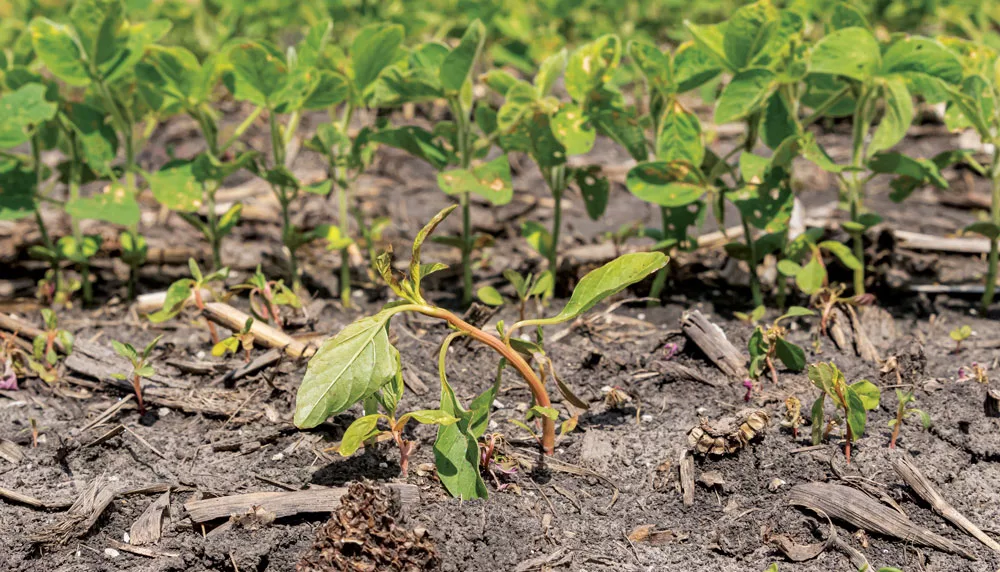
The first case of glufosinate resistance in waterhemp in the U.S. has been confirmed by the Univ. of Illinois, according to media reports.
Weed scientist Aaron Hager recently told Brownfield Ag News that resistance was found in about four populations of waterhemp in Illinois, “so it’s involved resistance to herbicides from eight different chemical classes.” Glufosinate products include Liberty, Liberty Ultra and Interline.
Hager told Brownfield this development isn’t surprising due to the increase reliance on glufosinate and the loss of efficacy with other herbicides. He noted not all glufosinate failures are due to resistance, but farmers would do best to limit seed production to reduce future generations of the weed developing.
This discovery is significant due to the reduction of post-emergence herbicide options available to soybean farmers. Hager says those farmers sometimes add glufosinate as a tank mix with a post-emergence herbicide for residual control, but if Group 15 herbicides have resistance issues the length of residual control will be lessened, he told the news outlet.
Glufosinate does best with bright sunshine, high humidity, high temperatures at 20 gallons of carrier to the acre, and medium-sized droplets, Hager says.
Hager also told Brownfield Ag News the Univ. of Illinois is also in the process of confirming that a population of giant foxtail showed resistance to Group 15 herbicides, which has not been seen in North America before.