Luke Koffman grew up on a small dairy farm in Eden, Wis., where conventional tillage was the standard. The third-generation farmer knew there had to be a better way.
That better way revealed itself in the summer of 2018 during the Wisconsin Farm Technology Days in Portage County. Luke and his dad, Ed, stopped by the Environmental Tillage Systems (ETS) booth and got an up-close look at a SoilWarrior for the first time. They were invited to a demo and were impressed by what they saw.
“I had already been reading about strip-till in No-Till Farmer and Strip-Till Farmer magazines, but seeing the practice in action for the first time had a wow factor to it,” Koffman says. “It was a transformative experience when we saw strip-tilled corn at the demo. After that, there was no going back.”
The Koffmans rented a SoilWarrior the following fall and put strip-till to the test with a side-by-side trial. One field was chisel plowed in the fall and cultivated in the spring. The other field was strip-tilled.
“The funny thing about that first year is the strip-tilled corn looked shorter,” Koffman says. “I called Dave Sender from ETS and said, ‘What did you get me into? This corn is a foot-and-a-half shorter.’ He kept telling me to just wait, height doesn’t mean anything. The strip-tilled corn, which was chopped for silage, ended up being 1-2 tons per acre better than the conventional corn. There was no going back after seeing that.”
‘Really Solid Practice’
The strip-till payoffs happened overnight for the Koffmans. Luke says their yields increased in 4 consecutive years from 213 bushels per acre to 214, 216 and 226 in 2024.
“We attribute it all to the soil getting to the level of health we’ve been chasing,” Koffman says. “Soil health is one of the top benefits of strip-till, along with equipment consolidation, increased efficiency, water retention and the fertility placement from an uptake standpoint is so much greater than just spinning the fertilizer on and cultivating it.”
“The principles of strip-till apply everywhere. The practices of strip-till are local…”
Koffman now helps other farmers cash in on those benefits through his custom strip-till business, Regenerative Farming Services LLC, which covers 6 counties in central Illinois. He says it was by “dumb luck” that the business got started.
“I bumped into someone in central Illinois who knew a few farmers that needed someone to make strips for them. I said, ‘Sure, I can do it. A road trip sounds like fun.’ The custom business took off from there because I believe in my core that strip-till is a really solid practice,” Koffman says. “Nobody was offering custom work in central Illinois back then. Even 7 years later, I’m still the only legit custom guy I know of.”
Koffman racked up thousands of miles commuting back and forth between his home farm in Wisconsin and his customers’ farms in central Illinois. But after business picked up, he walked away from the family farm in 2022 and moved to central Illinois to focus full-time on his custom strip-till acres.
“A bunch of farmers are starting to strip-till in the region, but there’s still a need for access to custom strip-till without the purchase price of getting started on their own,” he says.
2-Pass System
While some of Koffman’s customers had success with strip-till right away, like he did, others had to wait a bit longer to see the ROI. He’s seen higher yield increases on “rougher grounds,” where the improved nutrient placement seems to pay off the most.
“The past couple years were dry, but that’s when strip-till really started to shine,” Koffman says. “I have customers who also practice conventional tillage and vertical tillage on some fields. The strip-tilled fields handled the drought conditions the best, and yields didn’t drop off as much as they did on some of the fields that were conventionally tilled.”
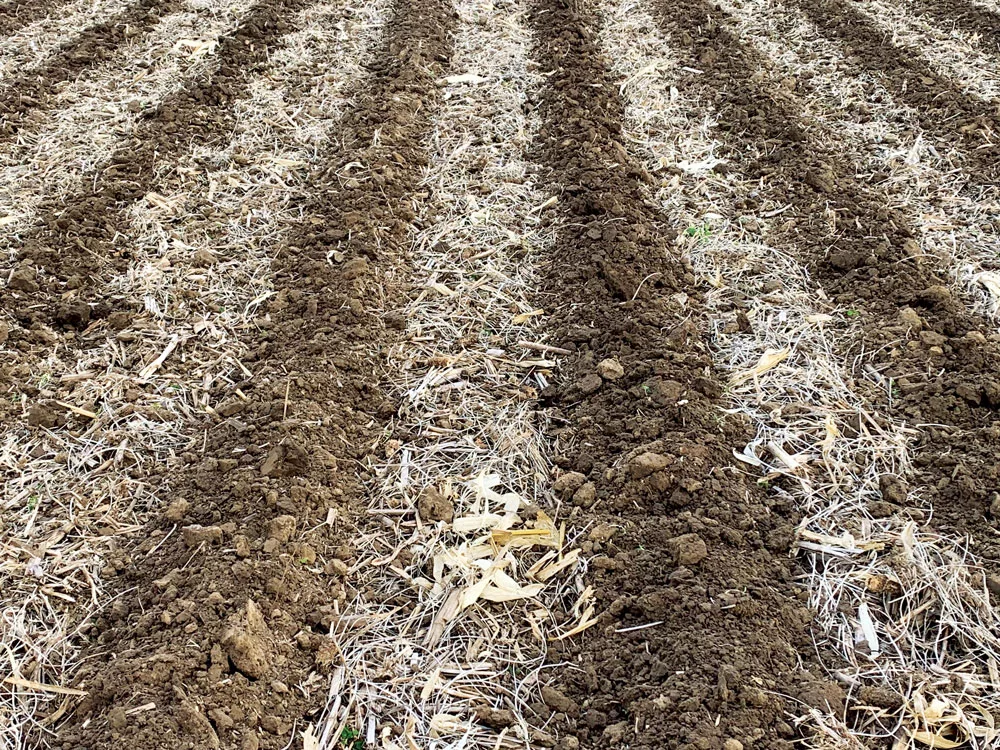
Koffman achieves consistent strip-till success with a 2-pass system. Using a 16-row Kuhn Krause Gladiator to make strips about 7 inches deep, he bands phosphorus (P) and potassium (K) in the fall and then applies nitrogen (N) and sulfur with a strip-freshener pass about 3 inches deep in the spring.
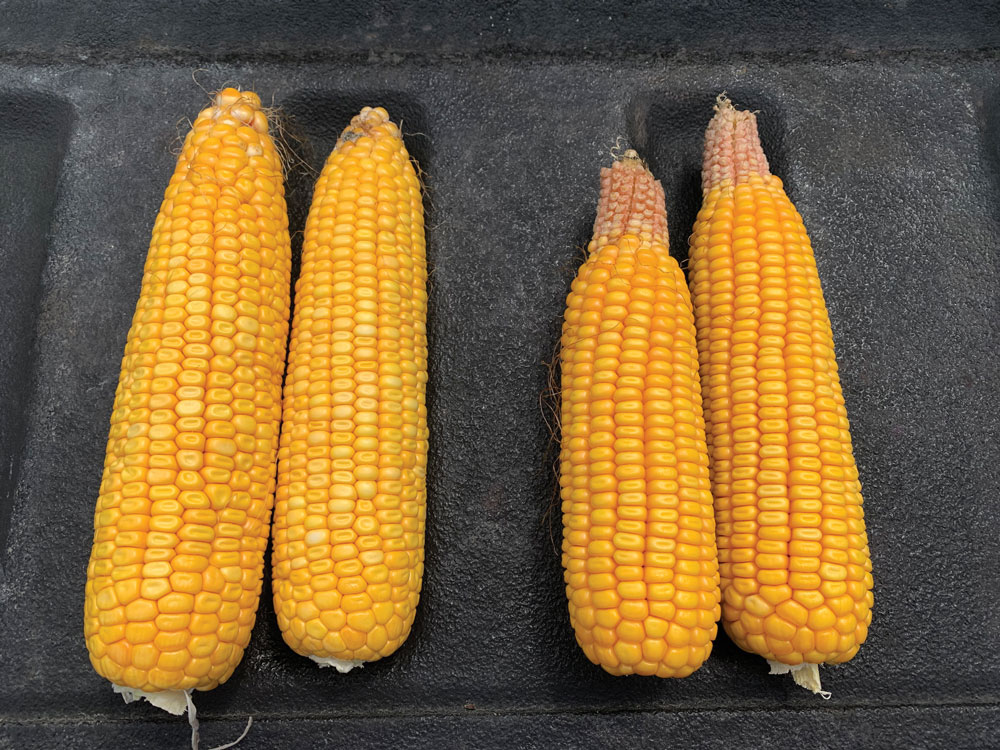
STRIP-TILL WINNER. One of Koffman’s customers conducted an on-farm trial comparing strip-tilled corn with banded fertilizer (L) to conventional corn with broadcast fertilizer (R). Strip-till came out on top as the winner. Luke Koffman
“I have a few guys who insist on a single pass and a few guys who handle nitrogen and sulfur with their planter, but most of my work is 2-pass,” Koffman says. “I made a coulter conversion kit for the Gladiator for the strip freshener pass.”
With corn prices being low and fertilizer prices ascending to “unreasonably priced” heights, Koffman wasn’t afraid to dial back fertilizer rates on some fields last fall.
“I applied anywhere from 0 pounds of fertilizer in fall strips all the way up to 200 pounds of MAP and 200 pounds of potash,” Koffman says. “With strip-till, we can make a pulled-back rate work just as well. I had one customer who said they’re waiting for prices to come down. By looking at their soil tests, I knew they had enough P and K out there to get by with nothing for a year. Now, that’s not sustainable long term, but it’s very economical short term.”
“By looking at their soil tests, I knew they had enough P and K out there to get by with nothing for a year…”
Fall P and K strategies vary in Koffman’s strip-till system, but the spring playbook for N and sulfur is relatively more consistent. He shoots for about 25 pounds of sulfur and 20 pounds of N ahead of soybeans, and 67 pounds of N and 24 pounds of sulfur ahead of corn.
“Keep the nitrogen in the tank for as long as possible, and put it out there at the right time, that’s what most farmers believe,” Koffman says. “60-75 pounds of nitrogen up front seems to be enough to carry the corn until V4-V8 when most of my guys sidedress.”
Equipment Truths
Looking ahead, Koffman plans to make the jump from a 16-row strip-till unit to a 24-row unit soon. He says more farmers are catching on to the benefits of strip-till, and having a bigger rig will allow him to cover more acres in a shorter amount of time.
“It’s not an issue in the fall, but by the second week of April, everyone wonders why I wasn’t there the week before,” Koffman says. “I’m hoping the bigger bar will let us get everybody done early enough so that no one is planting later than they want to be. The planting window is such a huge determiner of yield, and I want to make sure I’m not the reason my guys are being held up.”
Pairing Cover Crops with Strip-Till
Luke Koffman is a big believer in the combination of cover crops and strip-till. He considers strip-till the right boot and cover crops the left boot.
“My SoilWarrior had a cover crop seeder that allowed me to apply cover crops with the bar,” he says. “I have a few customers that apply cover crops with a no-till drill on soybean stubble, let it germinate for a week or two, and then I make strips through it. Having something alive and growing all winter, and keeping those microbes working underneath the surface, that’s a huge component to making strip-till work.”
Koffman relies on 2 big pieces of technology to make his operation run as smoothly as possible: RTK (real-time kinematic) and RCM (rate control module).
“RTK is the obvious one to make sure the strip-till tractor and the planting tractor are running good guidance,” Koffman says. “From a convenience standpoint and idiot proofing the whole thing, RTK would be the one big piece of technology you need for strip-till.
“RCM is the big difference between my first rig and my second rig,” he adds. “I run an RCM on the Gladiator that has iso scales tied right into the virtual terminal for calibrating fertilizer. You just hit ‘start calibration,’ run a few acres, calibrate, boom, done. That dials in the fertilizer accuracy so conveniently that anyone can do it.”
Equipment upgrades and tweaks are always a work in progress, Koffman says, but over the years he’s found that strip-till can work for different farmers with different goals on different soils.
“I’m going to quote Cambridge, Ill., farmer Monte Bottens on this one,” Koffman says. “He spoke at the Strip-Till Conference a couple years ago and he said, ‘the principles of strip-till apply everywhere. The practices of strip-till are local.’
“A farmer has to know why they’re trying to strip-till and then commit to making it work,” Koffman adds. “I’m on my 5th configuration of strip-till bars now. You might not get it right on the first one, but I guarantee for every acre out there, there is a bar that will perform very well on every field.”