TAKEAWAYS
-
Many new herbicides coming on the market have more tank-mix flexibility to help growers consolidate field trips.
- Avoid the temptation to cut pre-emergent and residual applications as it could cost you yield later.
- Explore what AI technology is bringing to the table for managing crop protection programs more efficiently and effectively.
Faced with another year of potentially high input costs and stagnant prices, strip-tillers will be hunting for ways to maximize yields and their return on investment with the crop protection tools they use.
To stretch soybean yields, many strip-tillers are planting soybeans earlier. But this increases the risk of early-season stressors chipping away at plant performance due to working in cooler and possibly wetter soils.
And with herbicide resistance in waterhemp and Palmer amaranth continuing to cause problems, weed control for row crops is becoming more complicated for row crops.
Jeremy Hawkins, southern regional sales manager for Helm Crop Solutions, says crucial weed-fighting chemistries are disappearing from the toolbox due to poor stewardship.
“The most important application is one that we’ve gotten away from as an industry,” Hawkins told Strip-Till Farmer during an interview at Commodity Classic. “When I first started in this business, we would always put some kind of residual and burndown behind the planter. And with the advent of Roundup Ready crops, a lot of growers got away from that. I think we are going to have to get back to that,” Hawkins said.
Syngenta agronomist Kevin Scholl said during a recent interview at Commodity Classic that in his area of northern Illinois, waterhemp is driving herbicide decisions, as the voracious weed has become resistant to several modes of action.
Having a burndown product in the mix for a pre-emergent herbicide applications is crucial to knock weeds out and give soybean plans a clean shot at emerging and growing, Scholl says.
In places where Palmer amaranth continues to emerge as a major problem, Syngenta’s management strategy is “kill the seed, not the weed” by using strong pre-emerge products to keep weed seed from germinating, he adds.
Eric Sherder, Corteva’s U.S. crop protection technical lead, agrees. “One of our strongest arsenals is our pre-emerge chemistry. That’s where we can get two, three modes of action. When we just go with a post-emergence product, that’s where we start having a lot of problems,” he says.
“Then we’ve got to make a second application, and you've also started to lose yield potential because the weeds have been competing with that crop for that length of time.”
Finding the Right Product
A frequent burndown choice for many growers is glyphosate plus an auxin, such as 2,4-D or dicamba. That combination can be effective but is probably being utilized too much, notes Brock Waggoner, a field sales agronomist for Helm.
The company has been promoting its PPO burndown herbicide Reviton as another mode of action that can be added for monocot and broadleaf weeds.
Syngenta’s Tendovo, a pre-emergence, selective soybean herbicide that combines S-metolachlor, metribuzin and cloransulam-methyl for broad-spectrum, season-long control Palmer amaranth, waterhemp and other weeds.
For corn, BASF recently announced Ridivex, an early-post premix with three active ingredients — diflufenzopyr, dicamba and pyroxasulfone — to control weeds quickly and maintain clean fields.
Sherder says many corn growers have been utilizing Resicore Rev, a pre- and postemergence herbicide, due to its effectiveness long into the season and wide window of application. Resicore Rev can be utilized well in tank mixes and can be applied up to 20-inch-tall corn, allowing for a more split application program.
For soybeans, Sherder advises growers to consider using a more premium program, “because I've seen the disasters when we get cheap.”
The company has announced the release of Kyber Pro herbicide, a pre-emerge product with 3 modes of action, including a group 15 active ingredient. It has broad-spectrum control of resistant broadleaf and grass weeds and offers lengthy residual activity.
“We’re planting beans now before corn in a lot of states. Beans are handling that stress a lot better. But once you put the pre out there, the clock is ticking and you’re going to see that you’re wearing it down,” Sherder says.
Tools for Fighting Diseases
In addition to weeds, crop diseases continue to erode the bottom line for growers. A Crop Protection Network (CPN) report on soybean disease loss estimates for 2025 outlined the continued impact of soil-borne and early-season threats, including sudden death syndrome (SDS), soybean cyst nematode (SCN) and red crown rot (RCR).
The report found RCR caused an estimated 7.7 million lost bushels in 2025, a substantial increase from only 121,354 bushels in 2024. SDS caused an estimated 49.3 million lost bushels — the highest since 2014 — and SCN was the leading cause of soybean loss again, although it was the lowest level in nearly 3 decades.
In all, an estimated 4.8% (216.5 million bushels) of the potential soybean production in 2025 was lost due to disease across 29 soybean-producing U.S. states.
in the CPN’s corn report, pathologists representing 29 corn-producing U.S. states and Ontario estimated the percent yield losses from disease, including root rots, seedling blights, foliar diseases, smuts, stalk rots, ear rots and nematodes.
Diseases reduced corn yield by an estimated 7% across the U.S. and by 2.2% in Ontario, resulting in a total estimated loss of 1.3 billion bushels. Overall losses were the greatest since 2018 but slightly lower than the average loss of 7.7% observed between 2012 and 2024.
Diseases that resulted in the greatest yield losses were the corn foliar diseases southern rust, tar spot and northern corn leaf blight, in descending order.
Syngenta experts say growers have been rethinking when and how they intervene and are shifting toward earlier, more proactive disease management strategies.
From a disease standpoint, Scholl believes timely applications of fungicides to prevent disease makes more sense than waiting for a disease to show up — “then you might be already behind the eight-ball letting a disease get established,” he says.
“We look at that VT or R1 stage on corn or R3 stage in soybeans to help best control diseases and also have a plant growth effect on those soybean plants, much like some of the biologicals that we have on our help with the abiotic stresses that are out there in the field.”
Red Crown Rot
Makes Big Move
Experts say an emerging disease in the Midwest plaguing soybeans is red crown rot, which is caused by the fungus Calonectria ilicicola. It was first found in North Carolina in the early 1970s and later in the Southeast and East Coast along the coast of the Atlantic Ocean.
The disease emerged in the Midwest in 2018 when it was found in Illinois, and it’s been observed in additional midwestern states.
Certain fungicide seed treatments may provide some suppression of the disease, and crop rotation with non-hosts can also reduce inoculum of the red crown rot fungus in an infested field.
The red crown rot fungus actively infects soybean roots when soil temperatures are between 77 and 86 degrees F, so the planting date and associated soil temperature also may influence red crown rot severity. Cleaning equipment to remove soil before moving to a new field may also help reduce the spread of the red crown rot fungus to a new field.
Syngenta has received EPA registration for Victrato, a seed treatment delivers broad-spectrum protection from nematodes, SDS and RCR with early-season suppression of foliar diseases.
Victrato tackles SDS and nematodes, including SCN, root knot, reniform, lance, and lesion. Its new active ingredient, TYMIRIUM technology — a carboxamide SDHI molecule — targets plant-parasitic nematodes and pathogens with “a precise receptor match,” the company says.
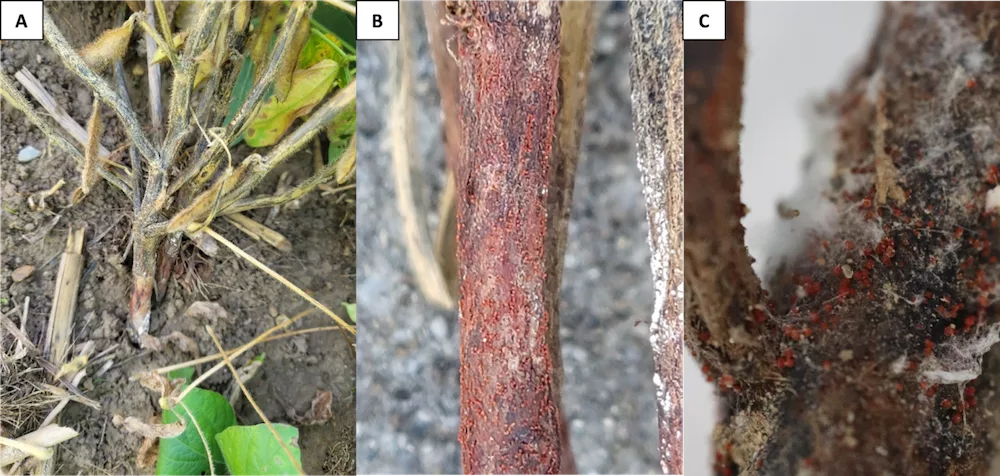
Red crown rot is similar from a symptomology standpoint as SDS, Scholl says. If growers see soybeans crash and die, he suggests they dig up a plant and check the roots. With red crown rot a reddish color can appear at the root bases.
With early-season beans, “controlling nematodes early season and having a good seed treatment for red crown rot and SDS are going to be paramount,” Scholl says.
Using AI to
Boost Fungicide ROI
Growers often face uncertainty when managing foliar disease due to shifting agronomic conditions and swiftly changing disease pressure. That can make decisions on fungicide application timing decisions difficult, as an untimely application can reduce efficacy, yield and return on investment.
At Commodity Classic 2026, Pioneer launched its Fungicide Timing Solution, an integrated approach to help corn growers make more data-driven fungicide applications and protect yield. Pioneer says the system has potential for a 5- to 10-bushel yield advantage over conventional approaches to application timing.
The program includes the Granular Insights fungicide timing tool with AI-driven data analysis, Pioneer corn genetics and Forcivo fungicide, a new product that has three modes of action.
The tool continuously evaluates field‑specific disease risk throughout the growing season, integrating localized weather, field conditions, management practices and hybrid disease tolerance. It’s designed to give growers actionable guidance on when and where sprays are most likely to deliver efficacy and yield potential.
Trenton Brisby, agronomy innovation marketing manager for Corteva, says the tool helps growers replace calendar‑based sprays and general guidelines with field‑specific timing recommendations. The tool factors in hybrid disease tolerance when analyzing data and generating recommendations.
Dealing With Variability
Forcivo provides both curative and preventative activity to protect plants from diseases. The three tools together provide a precise way to manage northern corn leaf blight, gray leaf spot, southern rust and tar spot, notes Madison Riggle, U.S. portfolio marketing leader for row crop fungicides.
Brisby said the project developed as researchers wanted to answer questions about fungicide applications and the problems growers have.
“What we see consistently is that weather variability, disease coming and going, growers are really struggling to understand when should I spray, if I should spray, where should I go? Am I going to get an ROI?” Brisby told No-Till Farmer at Commodity Classic recently.
“It seems like a lot of times that decision is happening in the field and an airplane's flying, the neighbor said something, the university, my dealer said something to me. When we started to think about technology and innovation, that’s kind of how this got started.”
Brisby says Corteva works with growers to map their boundaries, review soil types and management practices and input the information into the tool, which has built-in hybrid disease risk scores, so agronomists know how to handle different diseases the best.
We combine all that together and then every day we're monitoring what is happening in your field. And then based on the outcome, we're triggering where to go and when to go spray a fungicide.”
Riggle adds the combination of the AI tool for precise timing and Forcivo — which has a residual effect for 30 days — “is a one-two punch from a disease management perspective.”