TAKEAWAYS
- Save best acres for optimal planting conditions to boost overall farm production.
- In wetter, marginal conditions, run down pressure at the least amount needed to avoid slicking and compacting the sidewalls.
- If colder weather appears likely in the forecast during mid-spring planting, parking the planter for 1-2 days ahead of the temperature drop is advisable.
While many planters bound for the field this spring will have been refreshed with updated hardware, experts say paying close attention to 2026’s last-minute final setup, based on expected field conditions and short-term heat-unit accumulation, can mean finding “free” bushels at harvest.
Planter experts consulted by Strip-Till Farmer also agree time spent out of the cab checking planter performance in their individual fields is well spent to ensure optimal uniform planting depths and seed “micro-environment.”
Rarely do field conditions provide ideal planting environments according to the calendar, so every grower will face a variety of challenges when deciding when to plant. Planter experts we spoke with shared suggestions on this decision-making process, and on matching the planter to various conditions.
When to Pull the Trigger
Assessing field conditions and deciding when it’s too risky to plant comes down to a multitude of factors, and there are only two that can be addressed with planter preparation or design, says Bill Lehmkuhl, president and CEO of Precision Agri Services in Minster, Ohio.
“The first is the ability to close the seed trench properly. The other is what kind of downforce is on the planter. Can we lift on row units so we’re not causing too much compaction in the seed trench/zone? Beyond that everything else is an agronomic or economic question. There’s no cut and dried answer,” he says.
Picking a planting date is a good starting goal, but growers must also look at where they’re at with the traditional planting season for a given area and whether fields are too cold, wet or dry. The short-term and longer-term weather forecast also factors in.
“Growers need to look at overall moisture at planting depth, and what the yield penalty will be for planting in less-than-ideal conditions. What other cropping options are available? Is crop insurance available, and what are the economics of possibly taking a prevented planting claim?,” Lehmkuhl says.
“With corn, planting in mud or in long-term cold conditions will wreak havoc with uniform stands and ‘same day’ emergence so you’ll certainly be taking a yield hit. Then more than likely there will be increased drying costs. You must factor all of that into risky planting decisions.”
Missy Bauer of B&M Crop Consulting in Coldwater, Mich., says dealing with the cold is the easy part. She recommends growers consult weather websites for daily high and low temperature forecasts and then calculate daily growing degree days (GGD) using the following formula: (GGD = (Max Temp + Min Temp)/2) – 50 degrees F.
There are some websites and apps that will calculate GDD based on a ZIP code.
Another formula that works is GGD + previous GGD (also called cumulative GDD total) = new GDD total.
“It typically takes 100-120 heat units (GDD) from planting to corn emergence,” Bauer says. “If I plant my corn today and it’s going to take 8 days to emerge according to the heat unit forecast, I’m probably in good shape. But if I plant on a day when the weather forecast indicates it will take 13 days to emerge, I start becoming a little more nervous about a final decision to plant.”
Bauer says such scenarios also include one’s farm logistics. How many acres do you have to cover realistically and do you have the equipment and labor to do that?
“Until you get out of the tractor & dig behind the planter you really don’t know for certain what’s going on behind those row units…”
“In ideal conditions corn should emerge in 5-7 days,” she says. “If it will take 8-10 days, it’s likely we’ll be okay and we’re still going to run the planters. But am I going to plant that corn on my best acres? Probably not.”
In years with longer emergence windows, many growers will be planting their best acres first — likely because that’s what they’ve always done — and the best fields are usually those that are most easily planted because they are well-drained or tiled.
“If I can plant my best-producing, top 25% of my acres in the best emergence window (5-7 days), I’m giving the crop the best opportunity to provide the best yields and margins,” Bauer says. “With today’s economics, bushels are king, so I really want uniform emergence and stand uniformity out of the gate.”
Once expected emergence is more than 10 days out, she advises growers to delay corn planting and use their resources to keep planting soybeans.
“Some growers refer to red, yellow and green planting lights,” Bauer says. “Green light, we’re good, in that 5- to 7-day emergence window. Yellow light we’re encroaching around 10 days. Red light is greater than 11-12 days, and we’re going to have trouble with uniformity and emergence. Ideally, we’d like to stop planting.”
She notes 2025 was a tough year to use “rules of thumb” in much of the Corn Belt because cold, wet conditions had delayed planting, and by late-May conditions were more akin to late-April.
At Yetter Farm Equipment, AOR manager Andy Thompson seconds Bauer’s recommendation to track short and longer-term weather forecasts and soil temperatures when faced with tough planting conditions while trying to hit an available “sweet spot” planting date. Making sure soil isn’t too wet is very important. But he also notes monitoring soil temperatures offers growers some flexibility in tough conditions.
“I will push more and more based on soil temperatures combined with 5- and 10-day forecasts following the day I’m considering planting,” he says. “Generally, growers avoid planting until the soil temperature is 55 or 60 degrees, but I don’t mind going earlier if I feel confident the forecast says in the next 24, 48, or 72 hours we have a trend that’s getting warmer.”
Thompson says forecasts can be notoriously inaccurate, but watching temperature trends is doable and offers “fairly dependable” direction.
“If we’re cool and wet and we have 3 days of expected warming conditions but then we’re going back to cold, that’s not going to be good enough. We must use that entire 10-day forecast.”
If growers are planting during mid-spring when colder weather appears likely in the forecast, parking the planters 24-48 hours ahead of the expected temperature drop would be advisable.
Check by Digging
Today’s planter technology allows seeding in much wetter conditions than thought possible 20 years ago, Thompson says. While this provides a significantly wider planting window, he emphasizes it’s not a magic bullet to plant in mud.
“With the common double-disc opener planter we assume we have produced a firm V-shaped trench, and we put seed in the bottom of that V, firm it in, then follow along with a closing system,” he says.
“There are three steps to successfully closing that trench. First, we have to break the sidewalls, then we must marry the two sides of the trench together by zipping them shut from the bottom up, and then we must firm the soil around the seed on all sides.”
If successful, the process leaves a seed at the proper depth surrounded by friable soil with sufficient moisture and oxygen — and no visible trace of the original seed trench. Digging behind the planter is the only way to ensure that’s what’s happening.
Lehmkuhl recommends rather than merely digging down in the seed trench to check on seed spacing and depth, to dig from “outside the gauge wheel to outside the gauge wheel” on the row unit to get a look at the entire profile in which the seed will be growing.
“We’ll be looking for different things as we dig, such as how much compaction we’re causing alongside our seed trench, and are we firming the sidewalls well. Are we closing the seed trench 100%? Do we see a vertical line directly above the seed?
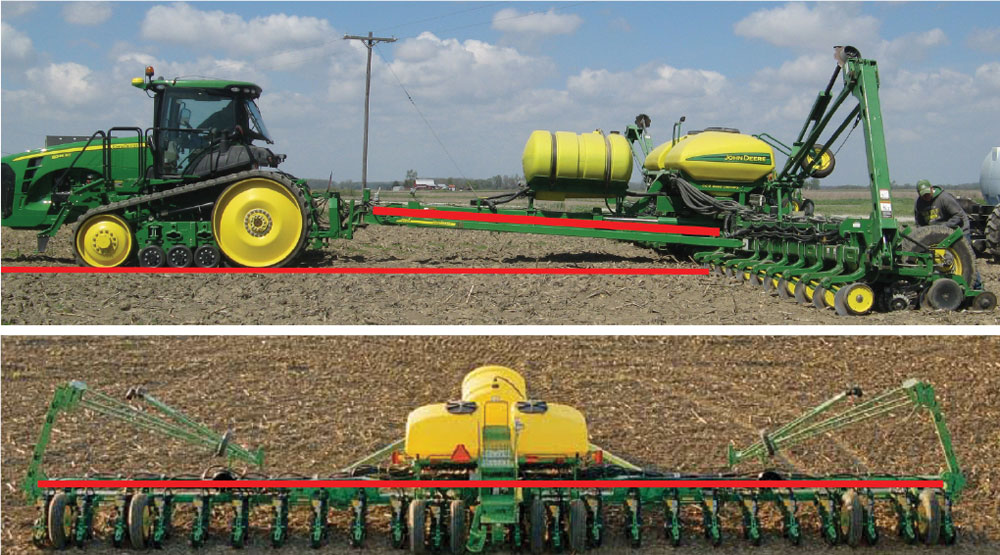
ON THE LEVEL. Keeping the planter level with the hitch point (top) and across the width of the planter (bottom) is key to maintaining proper planting depth. Advisors suggest carrying a tape measure and level to track planter orientation. Precision Agri Services
“I don’t want to see that line, I want it to look seamless, like you just poked the seed in with a straw and pulled it back out,” Lehmkuhl says.
He also recommends checking for any air gaps around the seed, and if there’s evidence of the sidewalls collapsing causing depth issues. "Also, is there evidence once the sidewalls have been broken, are they blending back together under the closing wheels?"
Thompson says his tool kit for checking planters in the field includes a level for checking levelness of the planter in the ground, a tape measure for toolbar height and seed spacing and depth, and a 4-inch and 1-inch-wide putty knife for examining the performance of closing systems.
“For a look at how our row units are performing, I’ll stick the wide putty knife perpendicular to the row down to the handle, that’s 4 inches wide and 4 inches deep. Then, I’ll take the narrow putty knife and dig back from the wide knife blade across its width 5 or 6 inches, and as I’m digging I’ll find a seed and set it off to the side to mark its location,” he advises.
“With the soil removed behind the wide putty knife I’ll pull it forward, leaving an undisturbed cross-section of the seed trench.”
Thompson says he can now visually inspect the trench for voids or air gaps. If there are, he says it’s because the left and right sides are not closed, not married together, or the planter is not providing the depth pressure needed.
“We may have the top closed, but as I go down 1.75 to 2 inches above the seed, do I start getting an air pocket there? Then, if there’s a line (a right and left side) evident in the cross-section, we’ve closed the trench, but we haven’t married it. There should be no line.”
He says if he sees even soil density and soil particle size and no air pockets that’s the key to finding what he calls “free bushels” at harvest, but he says there’s one more step.
“I want to examine how loose the soil is, so I take my little putty knife and start digging down on both the left and right sides of the ‘wall,’ going by feel. I don’t have a metric for what the resistance should be, but I know if I touch it with the knife and it caves in and falls, that’s a perfect example we are not running enough pressure, enough firming action.” Without sufficient firming action, a warm dry spell 24 to 72 hours after planting can wick moisture from the top down, a recipe for uneven emergence.
“If you plant in an environment that causes the corn plant to struggle within the first six growth stages, you’re going to lose yield & never recover…”
Adjusting down pressure can be tricky in wet conditions, however, and recommendations vary widely.
“Growers running in wetter, marginal conditions should run the least down pressure needed to hold the planter in the ground, without slicking the sidewalls and compacting them,” Bauer says.
“Many times growers run excessive down-pressure because the penalty of running with too little is so great. Still, in wet conditions it might be best to slow down and go lighter. I want that planter to ‘dance’ with light feet.” She suggests backing off an increment on down-pressure and digging behind the planter to determine if it helped any potential compaction problems.
As conditions begin to dry, Bauer says, examining the soil conditions around the seed might show a lack of moisture, which could indicate the need to drop seeding depth a quarter inch, and possibly adding more down-pressure.
Ethan Begle, Exapta Solutions, Inc., says in wet conditions more aggressive closing wheel pressure is needed to make certain the entire sidewall is fractured on both sides, but soil is left loose and not packed from the top down.
“A seed-firmer is so important to lock in the seed so you can be aggressive with closing from the bottom up. Also, no-till soils are more structured and all the roots work against any closing system trying to pinch it shut,” he says. “Closing in dry soils is the same, but uneven residue can create areas that are too dry and more packing will be needed to maintain moisture around the seed.”
Looking Back for Yield
Seed-to-soil contact and uniform planting depth are keys to success behind the planter. But A.J. Adkins, national sales manager for Iowa-based strip-till manufacturer Lynx Ag, urges growers to also spend some time visually inspecting their entire planter after an initial short planting pass.
Adkins spent a decade with Dawn Equipment and another year with Starkey Farms in Brownsburg, Ind., working on planter inspection and setup. He offers his own routine for a farmer’s first day of planting, or for each new field the planter enters.
“I know it’s hard to slow down once you get in the field with a 40- or 60-foot planter, but regardless of all the monitors you may have, you need to stop and make sure everything is working, from the hitch all the way back to the planted furrow,” he says.
He checks hitch height and scans the hydraulic system to make sure all the hoses are connected and the hydraulic weight transfer system is working.
“Many times the hydraulic downforce systems can raise the frame, and from the cab you can look back and see the frame ‘smiling at you,’ which means there are depth issues,” he says. “Look for levelness across the planter, not just from the side. You need sufficient weight on the ends to keep things level from side to side.”
The next step is looking at the whole planter from the back. “I’m looking at the gauge wheels and all the disc openers. I want to make sure all the closing wheels are centered over the seedbed slot,” he says.
From there, Adkins says he can move on to the furrow to dig to check on row-unit performance.
Adkins also recommends spending some early-season time with the planter in the field with the closing wheels pinned up.
“That way you can inspect the trench behind each row unit and make sure start/stop clutches are calibrated for optimal intervals,” he explains. “You can also check for seed singulation down the trench, long before you go to the field to plant the crop.”
In his planter clinics, Lehmkuhl emphasizes time invested in planter set-up to match field conditions goes a long way toward protecting the yield potential of expensive hybrids.
“I tell growers, if you plant in an environment that causes the corn plant (or any crop) to struggle within the first six growth stages, you’re going to lose yield that you’re never going to recover.”