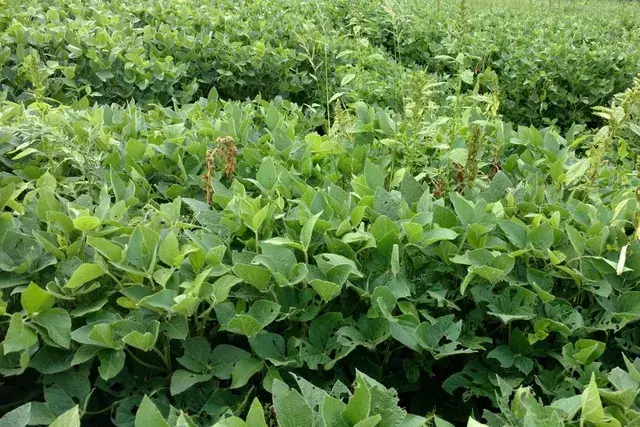
At this time of year, we receive various calls about what herbicides can still be sprayed to control pesky weeds and how late they can be applied. Keep in mind that not only will most of the weeds be too large for effective control but the crops are getting close to or beyond the maximum growth stage. Below are a few considerations about these factors.
Post soybean options
As a reminder, if your soybean crop is still within the proper growth stages, here are some herbicide options to consider:
- Glyphosate (group 9) in Roundup Ready-traited systems is still a viable option to control many weed species; however, it will not control glyphosate-resistant weeds such as marestail, Palmer amaranth, and waterhemp. In a standard Roundup Ready system, a 2x rate (1.5 lb ae) of glyphosate or a couple of in-crop applications of glyphosate usually stunts marestail. It is always best to treat them soon after they start regrowing from the burndown application. This will not control them but might suppress them somewhat if they are sprayed early enough. Keep in mind, marestail plants are generally not very tolerant of shade and most soybeans will begin to canopy over the marestail and outcompete them. See below for other herbicide options to control Palmer amaranth and waterhemp.
- ALS herbicides (group 2) such as Pursuit, Beyond Xtra (Raptor), Classic, Harmony, FirstRate still provide control of several key broadleaf weeds. However, ALS-resistant marestail and pigweeds are common in the state. FirstRate and Classic (plus glyphosate) can be applied to suppress ALS-resistant marestail and higher rates can be used in STS or Plenish systems. Classic controls cocklebur, smartweed, burcucumber, and provides suppression of certain perennials such as bindweed and pokeweed. Harmony is effective on lambsquarters, smartweed, and velvetleaf. FirstRate controls cocklebur, annual morningglory, and ragweed. Pursuit and Raptor are good on cocklebur, eastern black nightshade, and velvetleaf as well as annual grasses. These herbicides can be used in conventional or GM soybeans including Plenish.
- PPO herbicides (group 14) such as Reflex, Flexstar, Cobra, Ultra Blazer, etc. have activity on certain broadleaves. But keep in mind that not all of them have the same effectiveness on all broadleaf weeds. For example, Reflex/Flexstar, Cobra, Ultra Blazer provide good control of pigweeds including Palmer amaranth and waterhemp, and suppression of ragweed and eastern black nightshade, but have limited activity on marestail and are weak on lambsquarters. Cadet is great on velvetleaf but weak on other species including pigweeds, lambsquarters, ragweed, cocklebur, and marestail. In general, the pre PPOs (Valor, Authority, etc.) are effective on both marestail and Palmer. Any of these PPO herbicides can be used in conventional, Plenish, or GM soybeans.
- Glufosinate (group 10), the active ingredient in Liberty Ultra, Cheetah, Interline, Scout, and other generics, can be used over-the-top in LibertyLink, Enlist E3, and XtendFlex soybean varieties. It controls marestail, Palmer, waterhemp, cocklebur, lambsquarters, ragweed, and some others.
- Acetamide herbicides (group 15) such as Dual Magnum, Zidua/Anthem Maxx, Outlook, Warrant, Enversa, and a few others do not control existing weeds, but these should be included in the post spray mixture to provide “overlapping residual” control of weeds like Palmer and waterhemp. These weeds have a prolonged germination period during the summer and residual products will be necessary for adequate control through the season. Premixed products such as Prefix or Warrant Ultra are also available.
- Enlist E3 soybean varieties and registered 2,4-D choline (group 4) products (Enlist One and Duo) can be used in that system. These 2,4-D products cannot be used in Xtend soybean systems, otherwise major crop damage will occur. Enlist One provide control of several common broadleaf weeds, while Enlist Duo controls both broadleaves and grasses.
- XtendFlex soybean varieties allow the use of only registered dicamba (group 4) products over the top. Engenia and Stryax can be applied to the R2 growth stage while Tavium can be sprayed to V4 stage to control various broadleaf weeds. Be aware of the various application guidelines and restrictions when using these products in-season.
So how late can herbicides be sprayed on corn and soybean? Many herbicides have application restrictions related to the crop stage of growth, as well as, if the crop is being harvested for silage/forage/grazing or grain.
Corn
- Before corn emergence: Axiom, Princep/simazine, Verdict
- 2-leaf (V2 corn): Basis Blend, Balance Flexx, Bicep Lite II Magnum, Corvus, TriVolt
- 3 collars (V3): Surtain
- 4 collars (V4): Anthem Maxx
- 8 inches (V5): Clarity (1 pint/acre)
- 11 inches: acetochlor-containing products such as Degree (Xtra), Harness (Xtra and Max), FulTime NXT, Keystone NXT, SureStart II
- 12 inches: atrazine, Acuron, Bicep II Magnum, Cinch ATZ, Lumax EZ, Lexar EZ, Outlook, Resolve
- 18 inches (V6): Maverick, Perpetuo
- 20 inches (V6): Accent Q, Capreno, Liberty, Peak, Realm Q, Resolve Q, Shieldex, Steadfast Q, Python
- 24 inches: Kyro, Resicore REV
- 30-inches (V8): Acuron Flexi, Armezon Pro, Callisto, Enversa, generic glyphosates, Halex GT, Impact/Armezon, Prowl H2O, Warrant, Zidua SC
- 36 inches (V8): Clarity (0.5 pint/acre), DiFlexx, Status, Yukon
- 40 inches: Dual II Magnum
- 48 inches: Cadet, Permit, Roundup products
Soybean
Before bloom
- Pursuit and Raptor – PRE to before bloom and 85 days before harvest
- Liberty 280/Ultra (Liberty Link or varieties than include glufosinate-resistant traits such as Enlist E3, XtendFlex) – emergence to before soybean bloom (R1) and at least 70 days before harvest of grain
- Outlook – up to V5
- Anthem Max, Perpetuo, Zidua SC – up to V6
- Tavium – up to V4 (XtendFlex varieties only)
R1/R2 (bloom stages)
- Cadet – Preplant through full flowering and at least 60 days prior to harvest
- Engenia – can be applied from burndown up through R1 XtendFlex soybean growth stage
- Enlist One – can be applied in Enlist E3 soybean varieties only from emerge to through the R1 growth stage and do not apply within 50 days of harvest
- FirstRate – 1st soybean trifoliate through 50% flowering (R1) and at least 65 days before grain harvest
-
Glyphosate (Roundup Ready or glyphosate-resistant varieties only) - emergence through flowering
- Can be used as a harvest aid at least 7 days before harvest and when soybean pods have set and have lost all green color and 80-90% of leaves have dropped
- Stryax – can be applied from burndown up through R1 XtendFlex soybean growth stage
- Warrant, Enversa – up to R2
PHI restrictions (Preharvest intervals or days before harvest)
- Assure II/Targa – apply at least 80 days before harvest
- Basagran – after emergence; soybean is tolerant to Basagran at all stages of growth
- Classic (or Synchrony) – at least one trifoliate leaf up to 60 days before maturity
- Cobra – apply POST up to 45 days before harvest
- Dual Magnum – at least 75 days before harvest
- Harmony SG – after 1st trifoliate has expanded fully and no later than 60 days before harvest
- Reflex or Flexstar (or Flexstar GT with glyphosate) – PRE to within 45 days of harvest
- Select/clethodim – apply at least 60 days before harvest
- Ultra Blazer - at least one to two trifoliate leaves up to 50 days before harvest
Also, don’t confuse late post applications and harvest aid applications. Not all herbicides can be applied up to harvest. There are only several herbicides that can be applied as a harvest aid (e.g., 2,4-D, dicamba, glyphosate, Gramoxone, Aim and a few others) and these must be sprayed within a certain time period when the crop is mature and ready to harvest.
Harvest intervals: A number of herbicides have restrictions when harvesting corn or soybean for silage or forage. Harvest restrictions are based on the potential for illegal herbicide residues in the feed or forage. Although not generally a problem, early harvested corn may fall under some of these restrictions. Some pre corn herbicides such as atrazine, Acuron, Anthem, and Sharpen have intervals from 60 to 90 days; while others pre herbicides can be less than 45 days. For example, post applied products such as Steadfast Q and Resolve Q have a 30 day, Status a 32 day, Liberty/glufosinate a 70 day, Roundup a 50 day, and Impact/Armezon a 45 day harvest restriction for silage following herbicide application. Many of the pre and post applied soybean herbicides are not labeled for soybean forage but some that do include BroadAxe-30 days, Boundary and metribuzin-40 days, FirstRate-25 days, and, and Enlist One/Duo-56 days. Fortunately, in-crop applications of Roundup have only a 14-day harvest restriction, while other glyphosate products may vary regarding their harvest restrictions.