I studied agronomy at Iowa State after growing up on a diverse farm, and while I was there, decided to double major in horticulture, which turned out to be the greatest thing I’ve accidentally done.
There’s a lot more focus now on overall plant health, micronutrients and timing, a lot of things we used to control in greenhouses. When I first went into that sector, I didn’t realize we would use so much of it in modern agriculture today.
When I started farming on my own in late 2018, I transitioned to organic strip-till, which was quite the learning curve. But it taught me a lot agronomically. As of this spring, I’m no longer doing organic production, but that experience altered how I farm.
Profit Bushels
We need to change how we measure success. I use “profit bushels” as a metric on my farm. Yield is all I ever hear talked about. But I’m from a county where 146 bushels is average, so 170-bushel corn is profitable if you play your cards right.
The last 30 bushels in a high-yielding crop often costs a lot, and there might not be any money in it. I wish we could change the metric from bushels per acre to profit bushels per acre.
There’s a mindset in agriculture that when times get tough, you go back to what you know and don’t change anything. I think it’s the opposite. Lean times are when trying new things is most important, including different machinery, making fewer passes and increasing your efficiency.
“170-bushel corn is profitable if you play your cards right…”
We need to focus more on what we’re gaining from the fertilizer dollars we’re spending. Banding fertilizer with a strip-till bar and tissue and sap sampling improved my late-season fertility issues significantly. If what you’re applying doesn’t show up in the plant, how long do you keep doing it?
If you’re dialed in with strip-till, you don’t need as much fertilizer as you do with broadcasting. Variable rate fertility has saved me more money than anything else. Areas that don’t produce high yields don’t get fertilizer, and my overall fertilizer bill is significantly lower because of it.
Achilles’ Heel
Another thing I focus on is the Achilles’ heel. Every field has an Achilles’ heel — something holding it back, whether it’s moisture, fertility or soil type. For me, it’s usually water. Some things can be fixed, some can’t, and sometimes it’s not practical, especially on rented ground.
Yield maps are critical. Over time, they show what areas consistently struggle. Too many people just print them off and put them in a binder. Those maps tell you where your biggest problems are. I see many farmers focusing too much on the red areas on yield maps instead of pushing the green. Often the best areas become depleted because all the focus goes to fixing the worst parts.
Not every acre makes money. Some areas, especially near tree lines, lose money every year. In my travels, I’ve seen fields where 15–25% of the acres never make a profit, but they’re still farmed like the rest.
Soybeans, Covers & More
One of my strip-till “aha” moments was with soybeans. I started strip-tilling soybeans several years ago by accident and saw how well they performed. Now I’m strip-tilling 100% of my soybean acres. I plant fewer seeds, get better emergence, and maintain strong yields. Strip-tilling soybeans also saves time. I’m a one-man band and being able to move quickly in the spring matters.
Cover crops have been a big part of my system. I became more aggressive with cover crops when I saw how well a strip-till bar works through heavy biomass and how much herbicide I could eliminate because of the weed suppression.
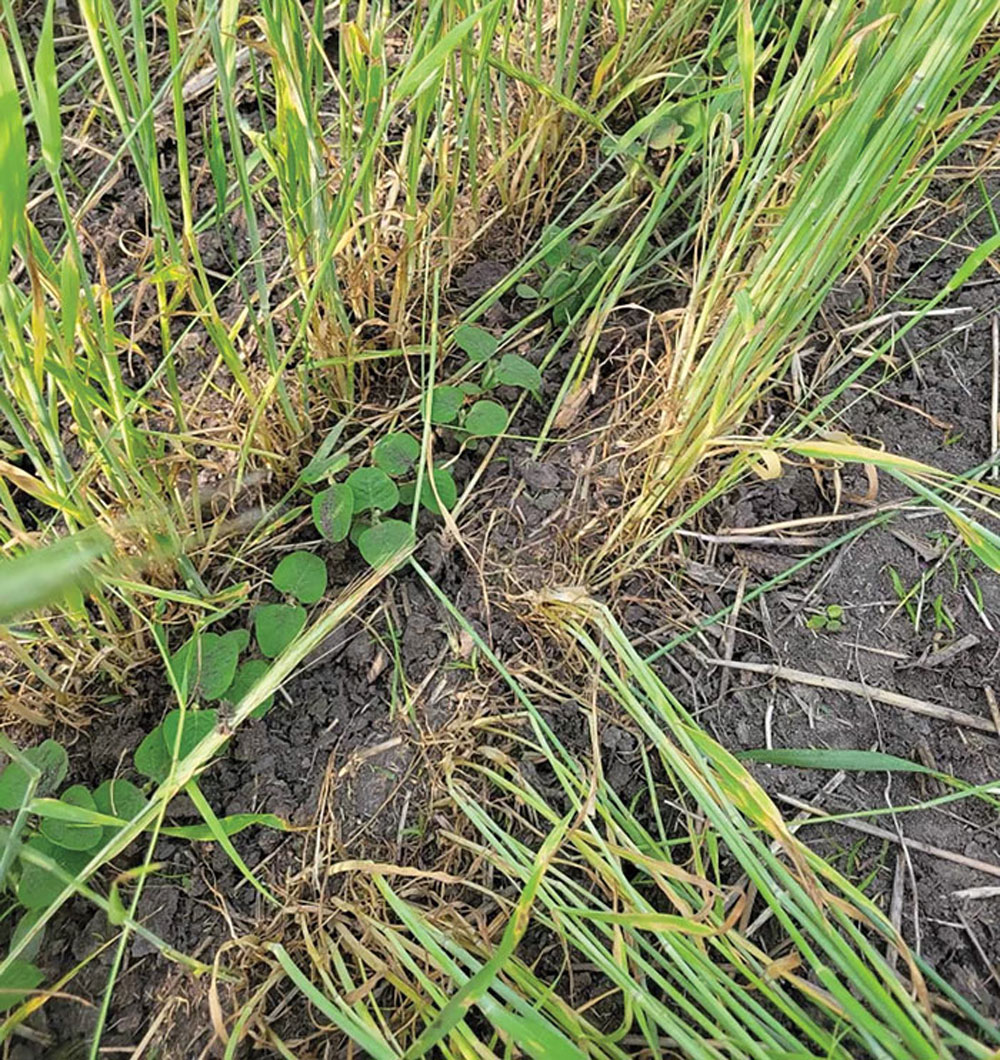
SOYBEANS & RYE. Strip-tilled soybeans emerge next to living cereal rye. Dobson usually roller-crimps the cereal rye before planting, but this particular year he rolled the cereal rye after the soybeans emerged. Mark Dobson
Fertilizer reduction is real. It still surprises me that I can raise soil test levels while applying less than what I remove. I’ve increased my efficiency by banding and splitting nitrogen (N) applications. With cover crops and proper nutrient placement, I’ve grown 240-bushel corn with much lower N rates.
Recently, I’ve started experimenting with strip-till alfalfa and more legumes. It doesn’t cost much to add legumes to a system, and they can act like a late-season N source.
Micronutrients are still something I’m learning about, but adding manganese and boron has made a big difference in my operation, as has manure management with RTK. By applying lighter rates and following with strip-till, I get the same effect with less product.
At the end of the day, my focus is on profit, efficiency and learning. Every field is different. The goal is to make better decisions and increase those “profit bushels” with the strip-till tools and knowledge we have today.