TAKEAWAYS
- Vertical tillage in the fall and strip-till in the spring can make for a winning combination.
- Managing residue not only makes planting easier but can speed up plant establishment.
- Vertical tillage can help strip-tillers address problems in the field without causing major soil loss.
Results of a recent Conservation Tillage Guide survey of vertical tillage users show many growers vouch for the practice and believe it’s a useful tool on their farm. Many indicated residue management was a top goal for using the implements, followed by cover crop seeding and fertilizer or manure incorporation.
Since its initial growth spurt in the early 2000s, vertical tillage has been the subject of many earnest discussions between devout strip-tillers and growers who seek to minimize soil disturbance but are unwilling to forego all tillage.
The practice calls for running nearly vertical disc blades in a shallow pass as the unit performs the desired task — often to cut residue and pin it to the ground with minimum soil disturbance so it will break down more quickly.
The 2025 Strip-Till Farmer Benchmark Report showed nearly 26% of strip-tillers are practicing vertical tillage on some of their acres.
The top equipment choices in the vertical tillage survey were Salford, Great Plains, John Deere and Kuhn Krause, in that order. Other brands cited by more than one respondent included Landoll, Case IH and Summers, with two respondents claiming homebuilt units.
Forty percent of those responding to the survey primarily use vertical tillage tools to incorporate and size residue to improve planting conditions or prevent residue movement by wind and rain, while 16% said the practice was most important for cover crop establishment. Many included both residue management and seeding cover crops, so percentages are somewhat skewed. Similarly, 12% singled out incorporation of fertilizer or manure as their top-of-mind use for vertical tillage, and many mentioned using it for pre-plant land preparation.
When asked what they do to minimize damage to strip-tilled or no-tilled fields when using vertical tillage, most emphasized using it only when necessary and running the machines as shallow as possible — usually 1-3 inches deep. “It’s tillage with a purpose, and never use it on bare ground,” one grower said. A few questioned why vertical tillage would ever be used in no-till management.
Strip-Till Farmer visited with several respondents to learn why vertical tillage is important to their operations.
Synergy with Strip-Till
About an hour-and-a-half east of Detroit, Ed Roodzant is a strip-tiller who says vertical tillage has earned a permanent place on his southwestern Ontario farm since he began the practice in 2009. In semi-retirement, Roodzant currently farms 300 acres — down from 1,200 acres several years ago — growing corn and soybeans.
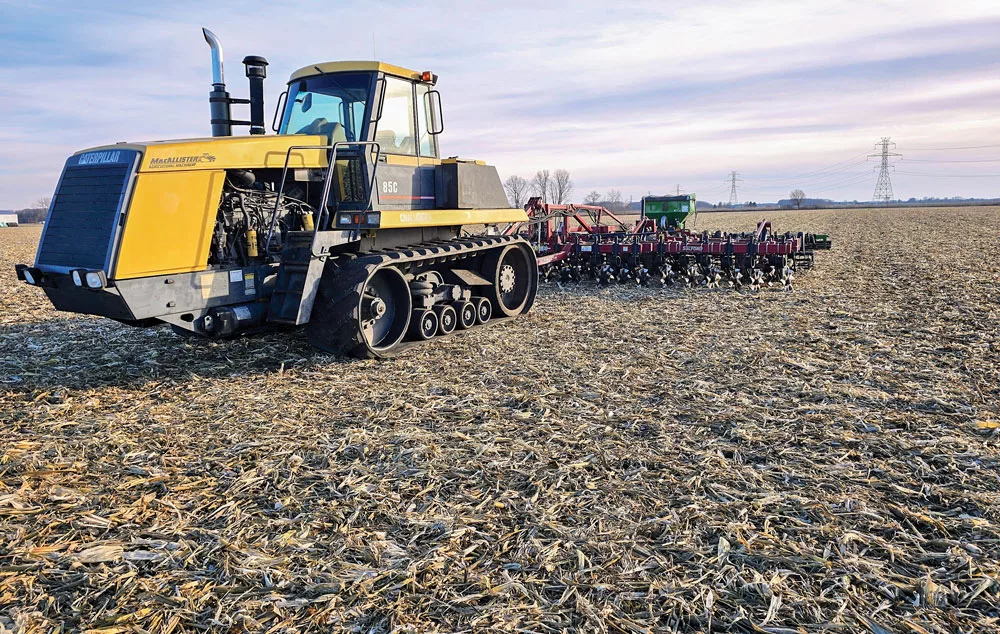
Over the past 10 years, his 220-bushel corn has produced heavy residue stands. He pulls a 24-foot Salford RTS in the fall a couple weeks after corn harvest to size and partially incorporate stalks.
“This provides better residue management the following season because it helps prevent the strip-till rig from plugging up with corn residue and root balls,” he says. “It’s also easier on the tires, and later in the season there’s less interference with Y-drops when we’re sidedressing 28%.”
Roodzant emphasizes that the fall vertical tillage pass runs only 2-3 inches deep to minimize soil disturbance.
“The beneficials have an easier time devouring the crop residue because it’s lying flat on the ground,” he says. “There’s no need to work it too deep.”
Roodzant follows the RTS strips in the spring with his 12-row Dawn Pluribus strip-till machine, applying fertilizer in the same pass. His 12-row John Deere 1770 planter equipped with Precision Planting 20/20 guidance, DeltaForce auto down pressure and CleanSweep row cleaner adjustment follows in the path of the Pluribus on 30-inch rows.
He plants a cereal rye cover crop after both corn and soybeans using the air cart on the Pluribus.
“I just don’t work as deep and leave the strips bare while seeding the middles, so I don’t have to fight root balls the following season.”
Vertical Tillage Transition
“I’m an extreme minimum-till guy,” says Vance Johnson, whose Minnesota farm lies along the North Dakota border in the Red River Valley. “I’m not a no-tiller, but I see vertical tillage as my ‘gateway drug’ into conservation tillage.”
Johnson, who rotates corn, soybeans, wheat, sugarbeets and cereal rye on 2,250 acres, says extreme erosion after heavy rains on some of his hilly fields convinced him he had to move away from conventional farming.
“We had a washout on those upland fields the size of a pickup truck,” he says. “To repair it, I filled it with dirt, but the following spring it washed out completely again. I knew I needed to change by disturbing those soils less.”
Johnson began using a Flexicoil unit equipped with coulters on those acres and the transition began. He’s been using vertical tillage since the spring of 2009 and 2010, when he couldn’t work corn stalks the previous fall because of wet fields.
He bought a 30-foot Summers Supercoulter to size overwintered residue in time for planting. Johnson runs the two gang implement with no angle on the vertical wavy coulters to reduce soil disturbance.
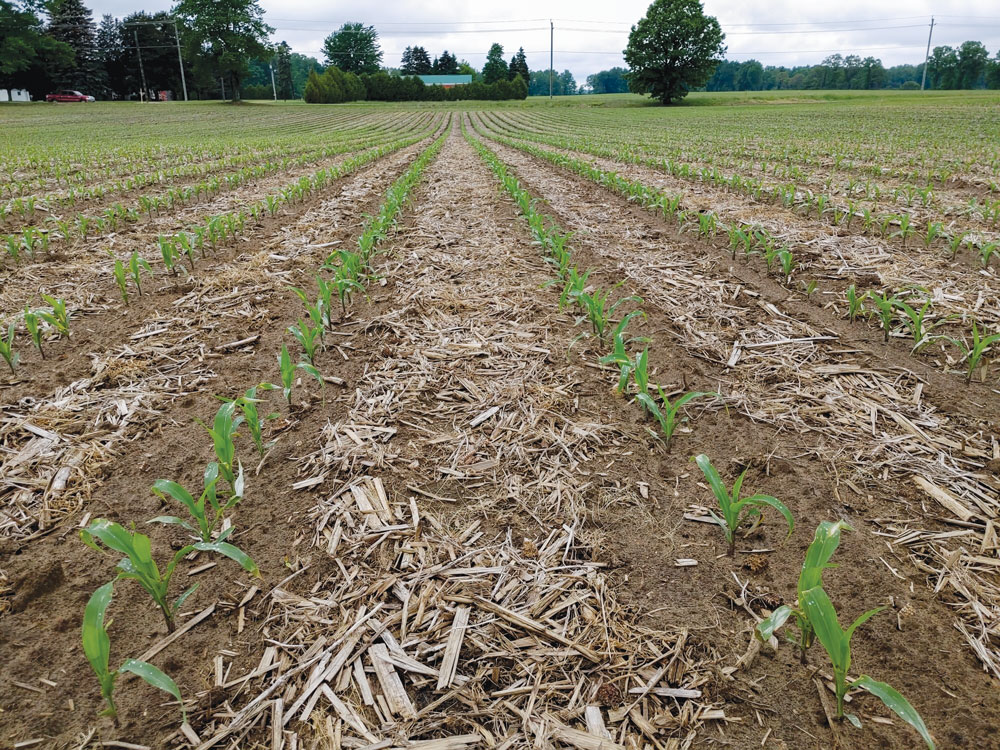
TOOL FOR CHANGE. Early season picture-perfect results from Ed Roodzant’s fall vertical tillage work with a Salford RTS tag-teamed with a spring pass in the same rows with a Dawn Pluribus strip-till rig. Roodzant says the RTS breaks down residue and moves it to the side to prevent root balls from choking the strip-till rig. The result is optimal planting conditions for his John Deere 1770 loaded with technology. Ed Roodzant
Using the machine to seed cover crops is another important task for Johnson. Ten years ago, he had a barley crop he left to grow, then planted soybeans in it with no issue — which led him to cover crops.
“We tried aerial application of cereal rye but were never satisfied with the stands,” he says. “So, I mounted a Valmar airbox on the Supercoulter and use it after corn harvest to plant rye. We use cereal rye behind corn every year and usually follow corn with soybeans or sugar beets planted green the following spring.”
To test the performance of vertical tillage and strip-till against no-till and conventional farming, Johnson borrowed a strip-till rig and ran a 5-year study using 20 acres of each. Each treatment was split in half testing cover crops against no cover. The same crops were used each year but rotated across the treatments.
“The vertical tillage and strip-till system was equal to or better than conventional till,” Johnson says, noting that in the heavy soils of his area, no-till seems to struggle.
While Johnson’s Supercoulter is now only used in the spring to incorporate fertilizer or to put on covers in the fall, it provides the total field preparation ahead of planting, which prompts Johnson to say: “You’d be hard pressed to get me to change. It’s what makes minimum-till and covers work here in the north country.”
Double Duty with Litter & Covers
Matt Johnson’s Salford 1224 vertical tillage unit gets a lot of use on his farm near Redkey, Ind., particularly for incorporating poultry-related residue.
“We use a lot of poultry litter of various sorts for various reasons at various rates and at various times,” he says. “The state requires us to work it in within 72 hours of application, and vertical tillage works well for us.”
Johnson gets double duty with vertical tillage as he sows cover crops at the same time he incorporates litter. The 1224 is equipped with a Valmar air system that Johnson says is also handy for sowing wheat and oats. The unit has also been used to establish grass in filter strips and waterways.
Different Machines & Tasks
Wayne Demmer and his sons run an 800-acre cattle, hog and grain operation just west of Dubuque, Iowa, and keep their Rogue and Kuhn Krause Excelerator vertical tillage tools busy throughout the season to incorporate manure, prepare corn fields for planting and establish cover crops.
Demmer says the family began using vertical tillage to manage corn stalks behind 220- to 260-bushel harvests, and unlike many vertical tillage proponents who say “run it shallow,” the Rogue unit sometimes runs more than 6 inches deep working through heavy residue.
“For corn on corn we run the Rogue in the fall,” he says. “In the spring, we use the Excelerator, running 2-3 inches deep to freshen the fields and then plant. Even though our fields are rolling, we get a smooth planting surface. Having been accustomed to deep tillage, we’ve noticed even with vertical tillage and field finishing we’ve maintained our yields. We averaged 240 bushels an acre last year across the whole 800 acres.”
The Demmers plant covers behind corn, and because of baling up to 1,500 bales of corn stalks and tending to the operation’s livestock, sometimes it’s November before cereal rye or an oat-mix gets planted on some fields. The family broadcasts cover crop seed with a fertilizer spreader and/or drone application, then incorporates it.
“We get 6-8 inches of growth even on those late covers, but the Excelerator works through it efficiently in the spring,” he says. “We’ve been doing this successfully for 3 years now, and the Excelerator is cheaper to run per-acre than the chemicals required if I was no-till.”