The future of profitable farming is alternative field arrangements, according to Lake Mills, Iowa, strip-tiller Zack Smith.
Smith, who gained attention in recent years with his autonomous mobile livestock barns, has been experimenting with what he calls the “weird stuff” for 15 years. After spending 18 years as a certified crop adviser and sales agronomist for Pioneer, Smith began crop sharing with his father and eventually started farming full time. He currently strip-tills 1,200 acres of corn and soybeans. His entire operation is 100% fall strip-till and 100% cover cropped.
Only a small portion of his acres are dedicated to experiments, but the discoveries made on those acres inform his entire approach to farming. Early trials with twin-row corn resulted in the creation of the Stock Cropper, a mobile grazing barn that guides a diversity of livestock between wide strips of corn.
After seeing the Stock Cropper’s positive impact on soil health and ability to add profit to his operation, Smith started thinking about how to scale the system and returned to twin-row corn. In 2022, he set up a plot next to the Stock Cropper path to compare the spacing of 30-inch-row corn, 60-inch twin-row corn and 90-inch twin-row corn as well as the performance of four hybrids in both systems.
“Hybrids act differently in these environments when you’re opening up solar gaps,” Smith says.
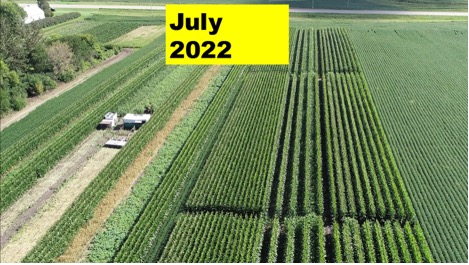
SOLAR STRIPS. Lake Mills, Iowa, strip-tiller Zack Smith set up this on-farm trial in 2022 to compare yields among different row widths and corn populations. “60-inch twin-row corn is what I would focus on if you’re interested in growing yield,” Smith says after years of trialing alternative field arrangements.
Smith planted three blocks at populations of 16,000, 25,000 and 36,000 with cover crops between the twin rows. The 60-inch twin rows yielded on par with 30-inch-row corn — with most yields in the 230-240 bushels per acre range. The 90-inch twin rows grew about 190 bushel-per-acre corn, but the increased cover crop biomass would benefit a farmer with cattle, Smith says.
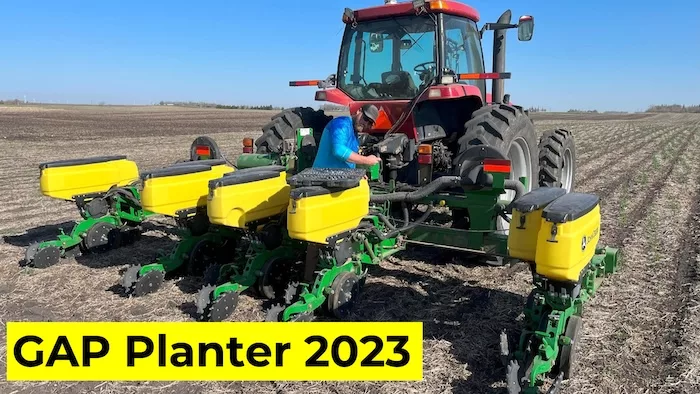
“My takeaway is there’s something here, and I need to get an actual twin-row planter to test this stuff further,” Smith says. “I was able to find a planter that winter that allowed me to create whatever type of gap I wanted and have everything be 8 inches on center.”
Hybrid Variability
In 2023, Smith used the gap planter to continue his 60-inch and 90-inch twin row corn experiments. He also tried 72-inch rows, “which makes no sense from a mechanical standpoint,” but he wanted to see if it would be a sweet spot between 60 and 90.
The 72-inch rows didn’t go as planned, and Smith decided to stick with 60-inch twin rows and experiment with ways to scale it across his farm. That led to a hybrid trial with surprising results, in part because of a planting error that resulted in a stand of only about 16,000-17,000 plants.
“The worst thing in the plot was 135 bushels per acre with Pioneer’s 14830Q,” Smith says. “That was the same year David Hula grew 623 bushels per acre with this hybrid.”
The highest-yielding hybrid in Smith’s trial, Pioneer’s 00177AM, produced more than 252 bushels per acre.
“Pioneer ended up squashing that hybrid that year because it didn’t perform well in 30s,” Smith says. “The only way to understand what works is to do your own trials. The seed company doesn’t have any idea when you get into these gap arrangements.”
Smith went to Pioneer with his results, and the company agreed to set up trials at several locations across Iowa to compare hybrid performance in 60-inch vs. 30-inch rows. Pioneer’s breeders recommended eight hybrids for the trial. Smith says the 60-inch single rows yielded about 90% of what the 30-inch rows produced, but the 60-inch twin rows averaged about 15 bushels per acre more than the 30-inch rows.
“Jerry Hatfield spoke at my field day in 2024 and said the gaps change the dynamic of the canopy substantially,” Smith says. “You’re getting increased gas exchange, specifically CO2 as the wind blows, and it cycles it back in more.”
Strip-Tilling Outside the Lines
Zack Smith discusses why he adopted strip-till and the evolution of his on-farm experiments in his presentation from the 2025 National Strip-Tillage Conference. Watch the replay here »
Quintuple BioPass
Hatfield, a USDA-ARS Hall of Famer and longtime ag researcher, believes the gap creates a CO2 pump that doesn't happen in a regular 30-inch canopy. With that takeaway, Smith was determined to scale 60-inch corn across more of his farm the following growing season.
However, he quickly realized 60-inch corn would create problems with weed control and cover crop establishment. That led to the idea to plant 60-inch twin rows with a 10-foot intercropped strip of small grains, a system Smith dubbed the Quintuple Biopass.
Quintuple BioPass uses 60-inch twin rows with a 30-inch single between them. The system leaves enough room to get a small platform head through the row, but still stays on a 120-inch tram line. The corn population averages out to 34,000, which would be the same number of plants as 30-inch rows but in a smaller area.
“In this system, you could go through with a 12-row corn head and harvest 2 strips of this at the same time, be able to plant oats or a forage, and then also have the ability to apply manure in season in between the crops,” Smith says.
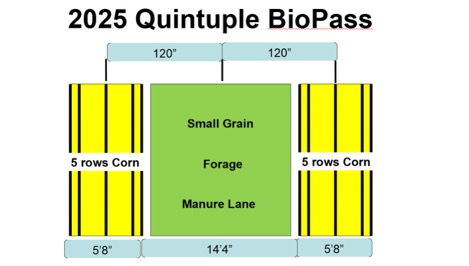
QUINTUPLE BIOPASS. Looking to maximize intercropping wide-row corn with small grains, Smith devised the Quintuple BioPass system. “It’s a hack that leverages the ability of the twin-row planter to get all those plants in there and then plant a single in the middle,” Smith says.
Smith says this layout is promising for incorporating large machinery, crop diversity and the ability to put on manure in season.
“Alternative field arrangements have a lot of promise,” Smith says. “They’re difficult, but when it comes to making farms more profitable without handing over more money or being dependent on Big Ag, there is a ton of opportunity for people who are willing to go outside the box.”
Related Content: