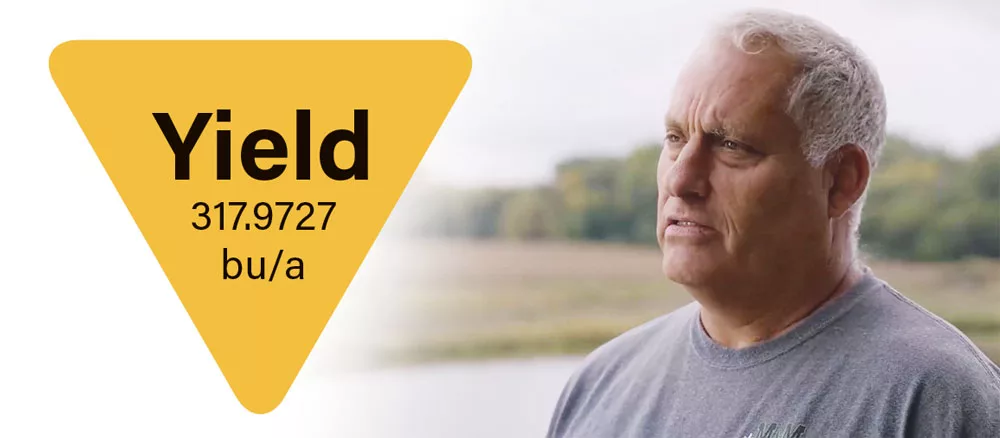
The Schleisman family had a banner year in Lake City, Iowa, as they swept the 2025 NCGA Yield Contest strip-till irrigated competition. Mark Schleisman was the state winner with just over 317 bushels per acre. His wife, Melissa, placed second with 311.9 bushels and their son, Matthew, was third with 311.7 bushels.
“We’ve been doing high-yield plots for about 6 years now,” Mark Schleisman says. “Every year, we try something new and learn what we can do across all our acres. Some things work and some don’t.”
Schleisman chases more than just high yields on his 5,500-acre operation that includes corn, soybeans, popcorn, hogs and a cow-calf operation. Soil health and water quality are always at the forefront.
Schleisman’s High-Yielding Formula
Yield: 317.9727
Hybrid: Merschman 2512C-30
Soil Type: Sandy loam (irrigated)
Planting Population: 32-38,000
Harvest Population: 35,000
Fertilizer: UAN 32%, thiosulfate, boron, zinc, biologicals, hog manure
Cover Crops: Cereal rye, rapeseed
Strip-Till Rig: 24-Row Lynx
Planter: John Deere 1775 NT with Precision Planting attachments
He plants cover crops on all acres and grazes them every fall and spring. The farm is also big on grassed waterways, buffer strips, wildlife habitats and bioreactors.
Shanks & Coulters
Schleisman started farming full time in 2010 after working as an agronomist in western Nebraska, where he managed popcorn production for Conagra. A couple years later, he experimented with strip-till.
“We did it the cheap way, following anhydrous marks with the planter,” Schleisman says. “Then we built our own strip-till unit, which was more of a freshener than a machine that can handle heavy residue.”
Schleisman ran a Yetter strip freshener unit for about 4 years. He recently bought a 24-row Lynx machine, which he uses to apply dry fertilizer — phosphorus (P), potassium (K) and gypsum — with a shank in the fall on corn-on-corn acres.
He switches over to a coulter setup in the spring to apply UAN 32% with ammonium thiosulfate. Corn following no-tilled soybeans only gets a spring strip-till coulter pass.
“We typically only use the fall shank on corn-on-corn ground where we have more residue to deal with,” Schleisman says. “The main thing we’re trying to do with the fall shank is prevent our manure application from getting stratified.”
Schleisman applies 2,500-3,500 gallons of liquid hog manure in the fall with a no-till coulter, and broadcasts about 7.5-10 tons of dry cattle manure on fields that don’t get hog manure.
Schleisman is a big believer in cover crops as a replacement for full width tillage.
“The root system from the cover crops, that’s our tillage,” he says. “It loosens the soil and creates channels for water to infiltrate. Cover crops also aid in weed control. Cover crops do everything for us.”
Schleisman plants cover crops in 3 different ways. He uses a drone on point rows, a vertical-till machine with an air seeder in soybean fields that can be harvested early, and a high-clearance machine on some corn acres that are harvested late.
“We pick and choose which fields each method will work best on, depending on the maturity of the crop we’re following,” Schleisman says. “We prefer vertical-till, but if the cash crop’s not going to come off early enough to get some cover crop growth, we’ll go with the drone or high-clearance unit.”
Schleisman uses cereal rye as the base for most of his cover crop mixes. He adds oats on fields that will be grazed heavily. He mixes in rapeseed and sometimes turnips or radish on fields that aren’t grazed as much.
Winning Formula
The 2025 contest-winning plot was on an irrigated sandy loam field following a popcorn crop. The championship journey began in the fall with a cover crop mix of cereal rye and rapeseed, which was then grazed.
About 3,500 gallons of hog manure was applied in the growing cover crop in the fall. Schleisman terminated the covers about 5 days before planting because it was unseasonably cold.
The field was strip-tilled in late April with the Lynx coulter machine about 2-3 inches deep and 10 inches wide, with 10 gallons of UAN 32% and 3 gallons of ammonium thiosulfate applied in the strip.
A few days after making the strips, Schleisman planted a Merschman 2512C-30 hybrid at a script population of 32,000-38,000 with his 24-row John Deere 1775 NT planter. The planter is heavily equipped with Precision Planting products, including an electric drive system, FurrowForce closing system and SpeedTube seed delivery system.
At plant, Schleisman treated his corn with Meristem’s Revline Hopper Throttle (containing zinc and biologicals) and Guard X, an EPA-registered bioinsecticide, to help with rootworm control.
Race to the Finish
The 300-bushel marathon continued with a Y-drop sidedress application of 10 gallons of UAN 32% and 3 gallons of ammonium thiosulfate around V13.
“That’s later than I normally like to sidedress,” Schleisman says. “But because we received so much rain, it turned out to be OK to wait because we didn’t lose any of that nitrogen.”
The plot also received 2 boron applications — 1 pint at V5 and another pint at V13. Schleisman says boron is critical for pollination and helps corn get through the stress of herbicide applications.
Schleisman says his decision to make 2 fungicide applications made all the difference in the world. The first application was pre-tassel with BASF Veltyma and the second application was 2 weeks later with generic Quilt.
“We geared up to do 2 fungicide applications because historically we get tar spot in irrigated fields,” Schleisman says. “But this year, it turned out to be southern rust. That second fungicide application really paid off. We did that on all our plot acres and all other irrigated acres. I wish I did it on more of our dryland acres too.”
Hindsight is 20/20, but if Schleisman could change one management decision with the contest plot, he’d bump up his irrigation rates.
“We thought we had enough subsoil moisture, but we ended up irrigating August 10 and again August 20 because it was so hot and dry,” Schleisman says. “The plot got about 3 inches of irrigation water. We probably should’ve started a week earlier and applied 4 inches.”
The corn was harvested at 17% moisture at a final population of approximately 35,000.
“Our goal is to harvest early when it’s about 27% moisture because we know there’s some phantom yield loss below that,” Schleisman says. “This corn was in the field longer than we normally want, but it stood great. It was very healthy-looking corn, even that late in the season.”
Key Takeaways
Schleisman has backed off on planting corn super early over the last several years. The contest-winning plot validates that decision, as his highest yields continue to come from fields planted later than others.
“If we can get everything planted around the last couple days of April or first few days of May, that’s when we get our best stands,” he says. “Cool weather inhibits uniform emergence when we plant early. We’re concentrating more on soybeans early and then switching over to corn as the soils warm up.”
Another big takeaway from the experience is to not put all your nitrogen eggs in one basket, Schleisman says.
“It was a very wet year until August. There was a big benefit to spreading out those nitrogen applications with hog manure in the fall, spring strips and Y-drops.”