
Sponsored by Case IH
Step into Robert Boyle’s office and one of the first things you’ll see is the giant, green Conservation Farmer of the Year banner hanging on his wall. The prestigious honor was recently given to him by the Arizona Association of Conservation Districts.
“It was nice to get recognition for all the work we’ve done, especially for air quality,” Boyle says. “I’m on the Governor’s board for air quality and we’re trying to solve the area’s problems with PM10 and PM2.5 dust. We’ve done all kinds of programs, combining passes to minimize dust and working the ground with moisture in it. It’s nice to be recognized for our strip-till and water conservation efforts as well.”
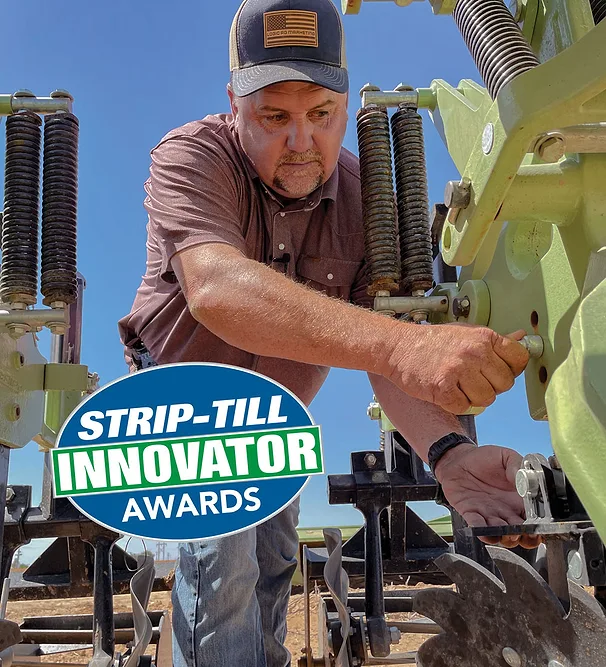
Boyle will need to clear some space on his wall for the 2026 Strip-Till Innovator Award. He was selected by an independent panel of judges as the recipient of the 8th annual honor for his strip-till, cover crop and water conservation trailblazing efforts in Coolidge, Ariz.
Spend a few minutes talking strip-till with Boyle, and it’s immediately clear the principles of conservation farming are important to him.
“I saw a quote at the Strip-Till Conference one year that said, ‘We borrow the land from our children, not from our fathers.’ That stuck with me,” Boyle says. “I’m doing this for my daughter, Emmie, and I’m borrowing her ground, so I need to leave it in better shape than I got it.”
Strip-Till in the Desert
Boyle is a self-proclaimed strip-till outlier in the Grand Canyon State, where his 1,200-acre irrigated corn, cotton, sorghum and alfalfa operation only gets about 7 inches of rain — if he’s lucky — and it often comes over the course of 2-3 big storms.
Boyle’s strip-till journey started several years ago when he was running a 3,000-cow dairy and custom hay baling operation with his family. A conversation with a dairy nutritionist sparked a transformation.
“I was in the dairy business my whole life,” Boyle says. “I’d buy the commodities I saw fit and then go to my nutritionist and ask them to help balance the diet and make everything cost-effective. During a meeting, the nutritionist told us he couldn’t cheapen our ration because our feed is too expensive. I started asking myself, ‘What can I eliminate?’ If I could eliminate 5-6 passes of tillage, that would put money in my pocket. The motto was I had to grow better feed at a lower cost as the neighbor, otherwise I should just buy the neighbor’s feed. That’s when I started looking at strip-till.”
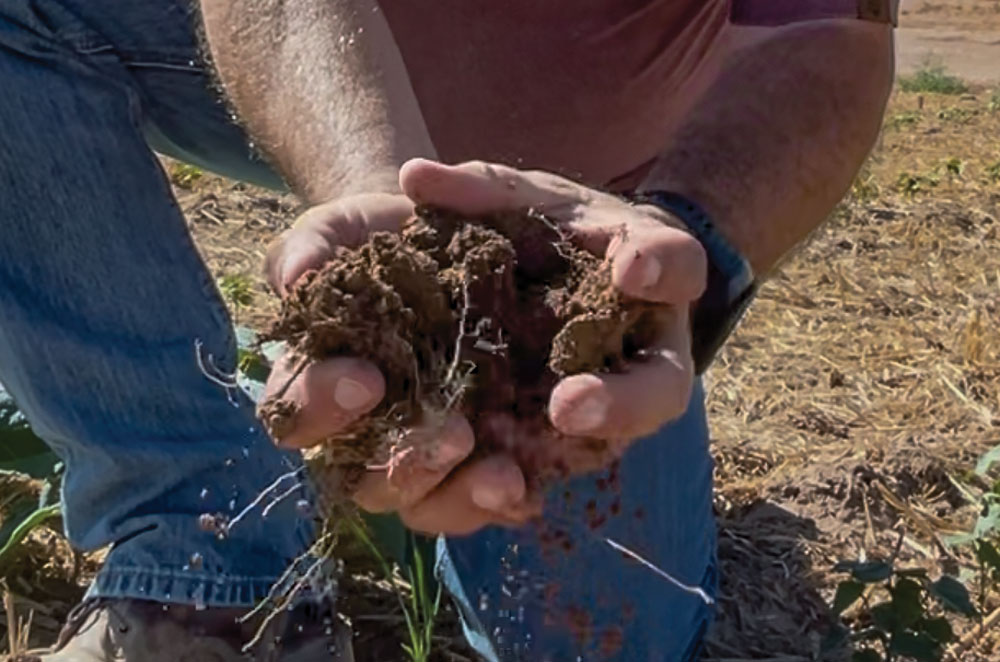
SOIL REVIVAL. Boyle worked hard to transform his soils with strip-till and cover crops. He was excited to find an earthworm on a recently planted cotton field, something that never would’ve happened several years ago. Noah Newman
Boyle asked his dealership, Stotz Equipment, for some information about strip-till and they connected him with Mike Petersen, Orthman’s lead agronomist at the time and Strip-Till Farmer Hall of Famer. Petersen and his team brought a 4-row Orthman 1tRIPr to Boyle’s farm so he could give it a try.
“Like most people in this area, I looked at it and the first thing I thought was no way it will work on this ground,” Boyle recalls. “I ran it on a few hundred acres that first year and I started thinking, ‘Hey, this looks like it could really change things for us.’”
In the years that followed, Boyle learned how to adjust the strip-till rig “a little bit better” for his sandy and clay loam soils and eventually unlocked major fertilizer savings.
“I upgraded to an 8-row rig and bought a Montag dry fertilizer cart because Petersen convinced me, ‘If you’re going to strip-till, put fertilizer with it, that’s where your savings are really going to come from.’”
“It took me a long time to screw up my farm and a long time to fix it…”
A few other farmers in the area have started strip-tilling after seeing Boyle succeed with the practice. They’ll stop by his farm from time to time to check out what he’s doing, but they mainly use strip-till for tillage, Boyle says, not to apply fertilizer.
“Nobody around here has really taken to the fertilizer aspect of strip-till yet, and that’s the key part of it,” Boyle says. “I’ve cut my NPK usage drastically, and with those savings, I’m treating the crop like a house plant in a pot and applying every micronutrient I can, including molybdenum, zinc, copper, manganese. We also use kelp and seaweed with our humic acids. I’m trying to buy better nutrients and get a better combination.”
Before making the switch to strip-till, Boyle struggled with diminishing corn silage yields and thought the only solution was more tillage and broadcast fertilizer.“I could apply 500 units of nitrogen, and it wouldn’t matter — my yields didn’t increase,” he recalls. “I was working the ground so much that I was beating it into flour, and the soil wouldn’t take any water. On top of that, fertilizer costs were rising. I was creating the perfect storm and causing all my own problems.”
Funding Cheat Codes
To help offset the cost of his strip-till equipment and 360 RAIN units, Boyle applies for funding through the NRCS Environmental Quality Incentives Program (EQIP). He encourages fellow strip-tillers to use his list of NRCS EQIP funding “cheat codes” below:
- Code 116 Soil Health Management ($2,400 payment)
- Code 328 Conservation Cropping Sequence ($28 per acre)
- Code 329 Residue and Tillage Management (No-Till) ($15 per acre)
- Code 334 Controlled Traffic Farming ($47 per acre)
- Code 340 Multi-Species Cover Crop ($90 per acre)
- Code 345 Residue and Tillage Management (Strip-Till) ($15 per acre)
- Code 376 Field Emissions Reduction ($16 per acre)
- Code 590 Nutrient Management ($38 per acre)
“If you have a lot of patience, this is a great way to get funding to help pay for a strip-till rig,” Boyle says. “The NRCS person may not know anything about cover crops, but if you tell them, ‘Code 340,’ they can start checking if you qualify. I go to my NRCS office with the list of codes and tell them to sign me up. I’m the only guy in Arizona who’s ever gotten the cover crop payment.”
Today, Boyle solves his problems with a trio of 8-row toolbars from different manufacturers, Orthman, Environmental Tillage Systems (ETS) and Zimmerman (ZML), using them to strip-till corn and cotton on his farm, as well as another 4,000 custom acres. He now focuses full-time on cropping after selling his dairy operation a few years ago.
“We essentially have a non-stop growing season,” Boyle says. “One of the biggest benefits with strip-till is we can turn a field around in 3 days. We can have the harvester, the strip-till rig and the planter in the field all at the same time and then come right back with our 360 RAIN unit to apply water and sidedress.”
Proof in the Pocketbook
Boyle crunched the numbers and determined his old conventional tillage program was costing him about $440 per acre, broken down as follows:
- Subsoiling 25 inches deep ($75)
- Second subsoiler pass or plow ($75)
- Offset disc to break clods ($40)
- Land Plane to smooth field ($30)
- Laser leveling ($95)
- Finish rip, loosen hard ground ($65)
- Broadcast fertilizer ($15)
- Plant corn/cotton ($45)
“I used to take my alfalfa out in October, and then from October to February, all I did was tillage,” Boyle says. “With strip-till, I can keep the alfalfa in longer and get an additional 3 cuttings. And then in a 2–3-day turnaround, I strip-till in February and plant corn shortly after. We’re getting way more revenue from those acres now.”
On top of that, Boyle estimates his strip-till system only costs about $145 per acre, nearly $300 less than the old conventional program, broken down as follows:
- Kill alfalfa with Roundup, sprayer pass ($25)
- Strip-till and band fertilizer into strip ($75)
- Plant twin-row corn, 40,000 seeds per acre ($45)
Crop rotations differ by field across Boyle’s operation. But on one field, for example, his rotation starts in September with alfalfa. Boyle then interseeds a “triticale cover crop mix” with oats, peas, vetch, clover and kale into the alfalfa in mid-October, and then the triticale is harvested in February ahead of corn, yielding 3-4 tons.
He strip-tills corn in 30-inch twin rows with his 8-row ETS SoilWarrior Edge a few days after triticale harvest.
“Our 8-row twin-row planter makes it to where the tram lines are only about 22.5 inches wide,” Boyle says. “We block off a plate on each side of the wheel traffic and then double the population in the next plate. We’re running about 72,000 seeds per acre on that single row and 40,000 seeds per acre on the double row.”
My Strip-Till Arsenal
No two fields are the same on Robert Boyle’s farm, just like his strip-till equipment. He uses the following 8-row units to get the job done on different fields:
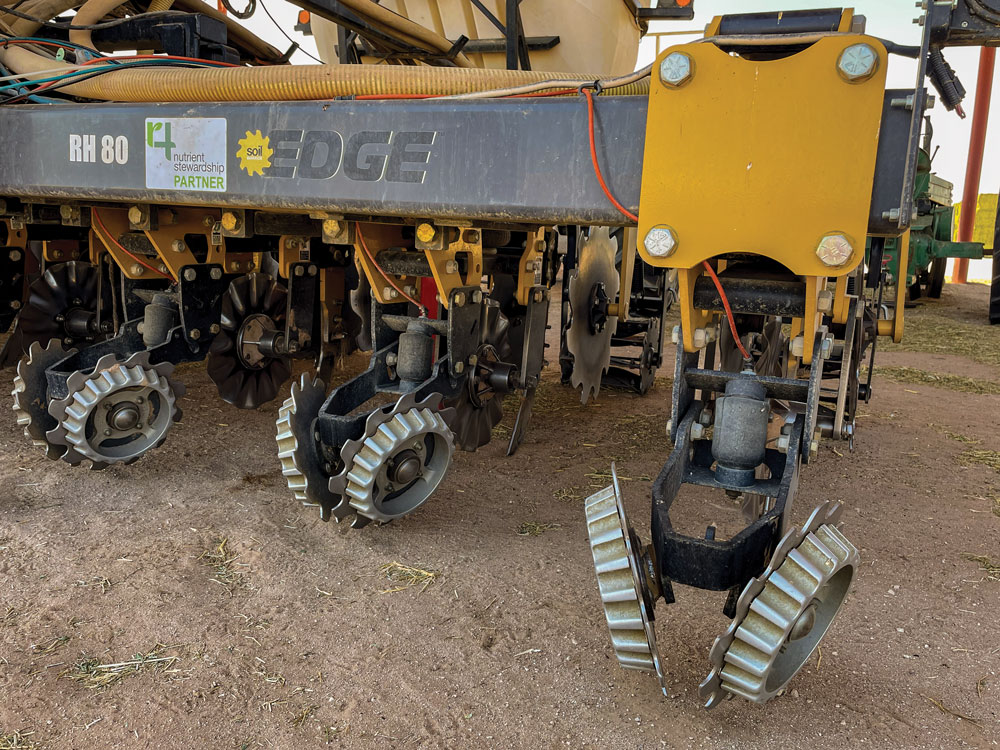
ETS SoilWarrior Edge. “I ended up buying the SoilWarrior Edge after a 1-year lease because I really like it for certain conditions,” Boyle says. “We use this for our twin-row corn. The containment cogs in the back are a bit wider, and with the shank design, we can actually do twin rows. This one also handles alfalfa very well.”
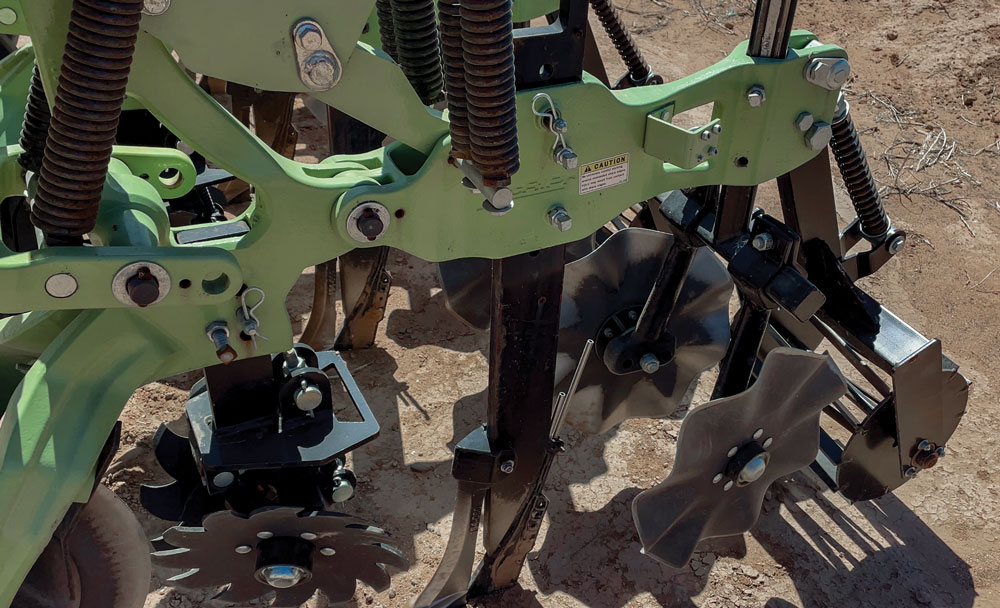
Orthman 1tRIPr. “This one gives us some flexibility,” Boyle says. “We can go out a little bit wider with the containment coulters and the wavy coulters. It gives us more variation in depth. The one thing about Orthman, they’ve always made things very simple to adapt.”
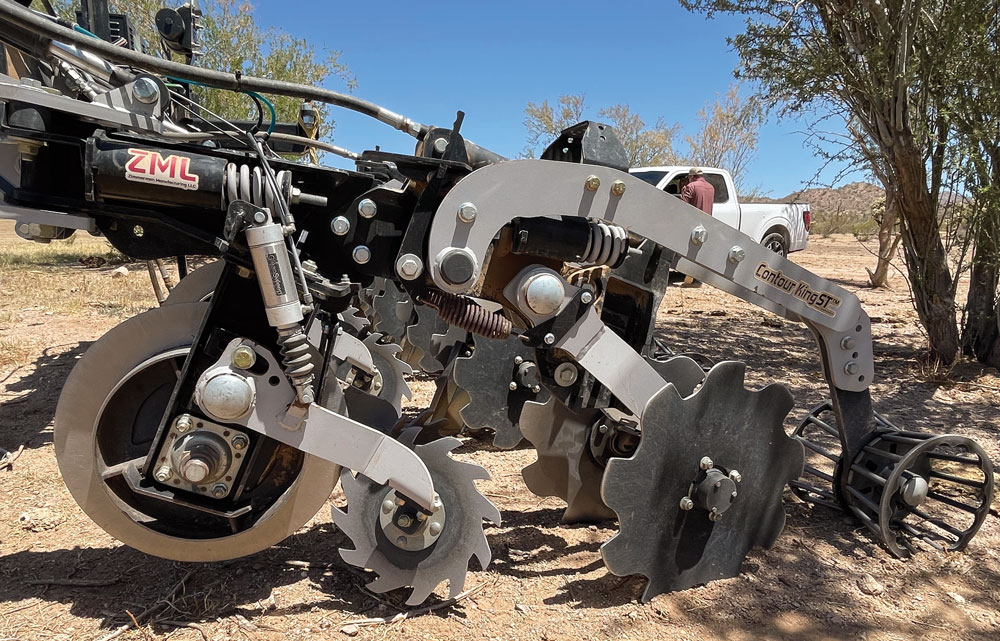
Zimmerman (ZML) Contour King. “I really like this one for cotton,” Boyle says. “This has an oscillation point, so it has range of motion when you’re going around in a circle, which helps bring the shank around. If I’m strip-tilling on a field with a lot of rocks, I want something with hydraulic auto resets, which is what this one has.”
“Each brand is designed differently and it’s nice to have different tools in our toolbox for different situations,” Boyle adds. “It’s crucial for us to have parallel lift and the parallel linkage because when we’re strip-tilling and we get to a dirt border, one row unit may be 7 inches up and the other row units are down. Being able to have that range of motion on each row unit is very important to us.”
The corn is harvested in mid-July and can be replanted for a second cash crop to be harvested in November. About 30% of Boyle’s farm is left fallow in the summer due in large part to local water restrictions.
“We used to farm 100% of our acres, triple-cropping triticale and corn, and then sorghum and corn,” Boyle says. “With the drought on the Colorado River, water supplies have been curtailed, and we’ve reverted to ground water. We now grow as much winter feed as we can between alfalfa and cover crops. We can get 10-12 cuttings of alfalfa in a year.”
Proof in the Soil
While strip-till is clearly boosting Boyle’s bottom line and overall efficiency, what it’s doing for his soil is priceless. The transformation was on full display when he stuck a shovel into one of his recently planted cotton fields.
“Look at that!” says Boyle as he holds an earthworm in the palm of his hand on a 100-degree day in late May. “This is a trophy. Fifteen years ago, this was an afterthought. There never would’ve been a worm in this place. To find an earthworm with the first shovel out of the ground, that’s just unheard of in Arizona.”
But the change in soil life didn’t happen overnight. Boyle says his soil health journey is an ongoing process. Every year is different and he never stops looking for opportunities to improve.
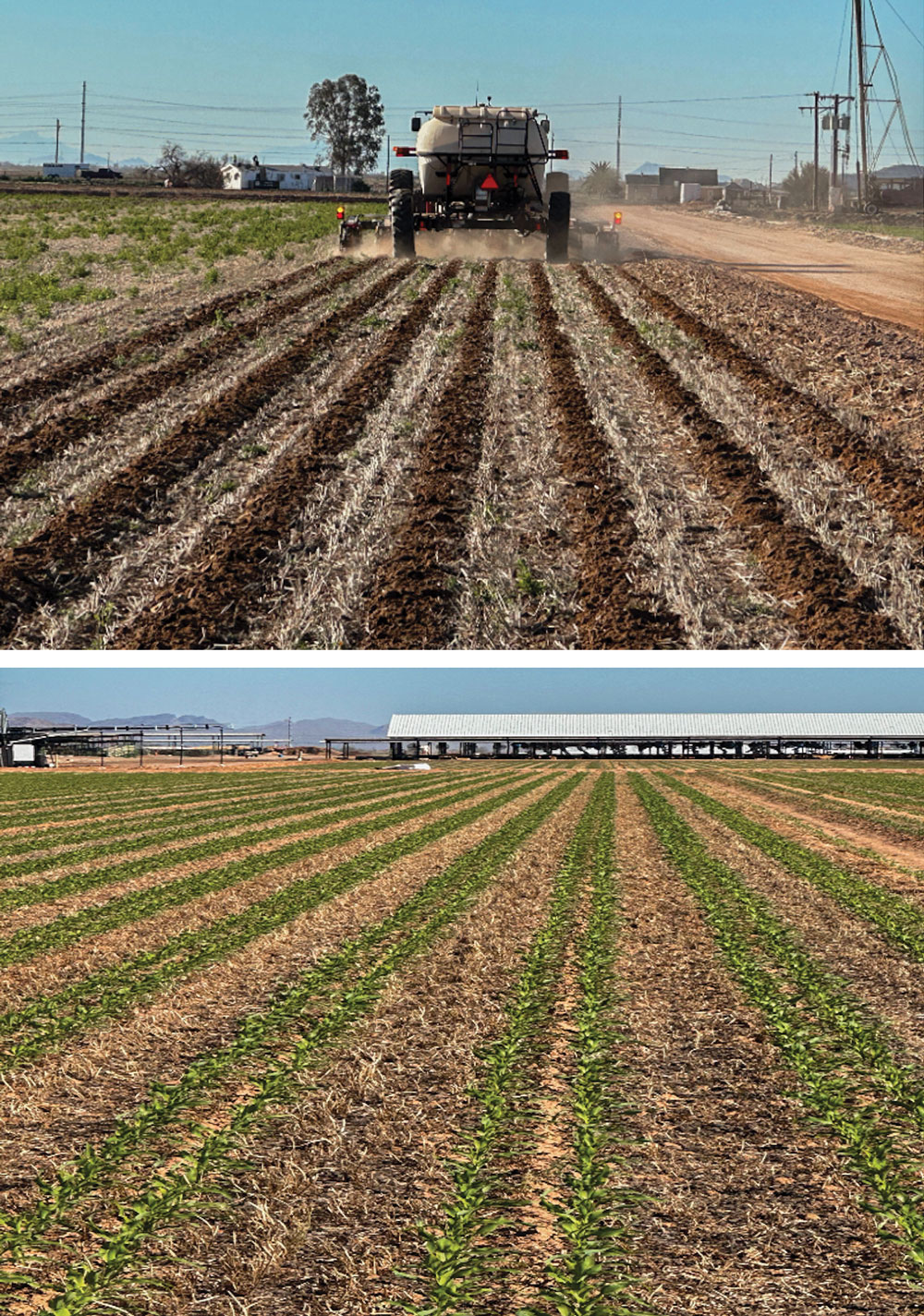
TWIN ROWS. Boyle strip-tills corn shortly after triticale harvest in February. He harvests the corn in July and replants a second cash crop to be harvested in November. Noah Newman
“Anytime you make a correction or change the path of how you’re doing things, you’ve got to give it at least 3 years to come around,” Boyle says. “It took me a long time to screw up my farm and a long time to fix it. And don’t be afraid to farm ugly. I don’t mind a few weeds. I don’t mind some stubble sitting out there. I’d rather have that than the picturesque fields of bare ground with no soil structure or biology.”
The field where Boyle dug up the earthworm went through a cover crop-fallow-cover crop cycle before he strip-tilled cotton into it. Boyle was so impressed with the soil in 2026; he wasted no time planting.
“Most guys around here ‘wet plant’ the cotton, but the ground looked so beautiful, I was just tickled pink with it,” Boyle says. “We just went ahead and ‘dry planted’ it.”
Covering Up
Cover crops are a huge part of the strip-till equation for Boyle. He started using them a few years ago after realizing his best corn yields were on fields following alfalfa. Boyle’s initial goal was to add a legume cover crop between multiple years of corn-on-corn.
“We like oats for forage, hairy vetch and clover for nitrogen fixation and radish and turnips for ground conditioning, but the forage harvester didn’t like them very much,” Boyle says. “We have rotary hay rakes, and our fields started looking like Topgolf. We were just beating up the tractor windows with turnips. They’d also come out of the ground with dirt on them, and they’d set off the metal detectors on the choppers. That’s why we started using kale as an alternative.”
Behind the Scenes with Robert Boyle
The cameras were rolling during Strip-Till Farmer’s tour of Robert Boyle’s farm. In the Strip-Till Innovator Video Series, Boyle details one of his most diverse crop rotations, explains how to capture strip-till success in dry conditions, showcases his 3 strip-till rigs and more. Click here to watch!
Boyle plants about 80 pounds of cover crop seed per acre with his Great Plains drill, more than enough to produce up to 100 units of residual nitrogen (N), saving him an estimated $71 per acre on inputs.
“And some of these things are hard to put a number on, but we’ve definitely seen an improvement in soil health since we started using cover crops,” Boyle says. “We see a deeper-colored green in the corn and it’s 2-feet taller.”
Boyle credits a big chunk of his soil revival to cover crop mixes and the pivotal role they play in a scorching hot, dry climate.
“When it gets to be 120 degrees, the surface temperature of that ground is going to be 135,” Boyle says. “The cover crop stubble makes all the difference in the world to keep that biology alive in the soil. Without it, that worm isn’t going to be living in the soil. It’s going to be cooked.”
Waterworks
Boyle strip-tills cotton in 38-inch rows on fields following alfalfa or triticale in April, using his ZML toolbar to make strips 8 inches wide and 10 inches deep. The narrow strips help conserve precious moisture, he says. And by strip-tilling his corn in 30-inch rows, with 12-inch bands, Boyle calculates he’s only truly farming about 40% of those total acres.
“Why spend money on the other 60%? When you broadcast fertilizer, you’re covering every acre. When you band fertilizer, you’re consolidating it underneath the plant,” he says. “You can use a lot less fertilizer.”
Boyle takes this same approach to his water management and only irrigates about 40% of his acres. He keeps the soil between the strips as undisturbed as possible to reduce water penetration (outside the strips) and weed pressure.
“We want the water to go right into the strips and suck it up like a sponge,” Boyle says. “On our fields that are flood irrigated, when we strip-till, we want that water to go right into the root zone. As soon as you shut off the water, it soaks in instantly because those strips are nice and mellow.”
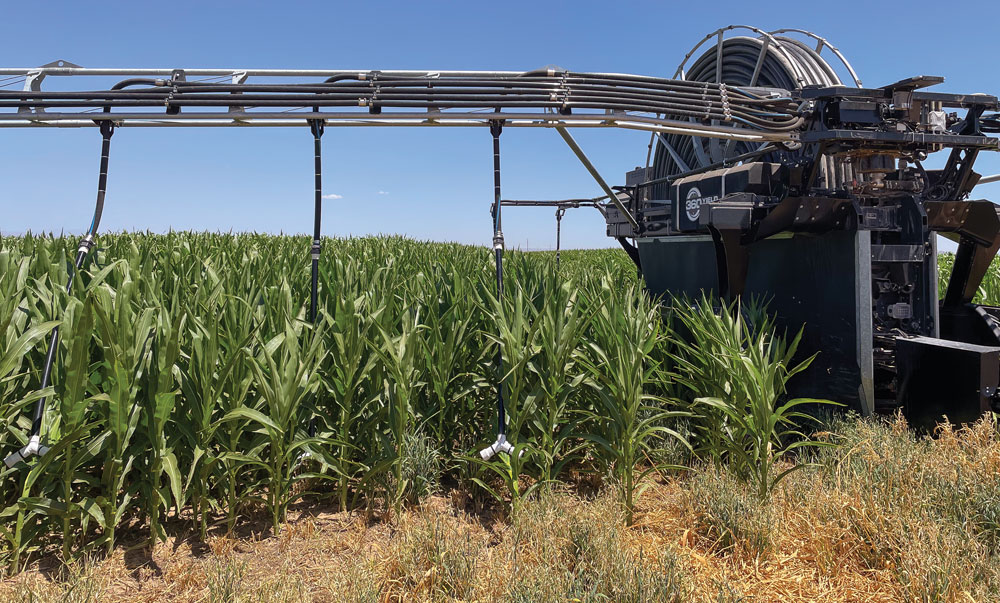
WATER CONSERVATION. A 360 RAIN autonomously irrigates and sidedresses one of Boyle’s strip-tilled cornfields. Boyle estimates he’s cut his water usage by 50% with the technology. Noah Newman
Boyle runs a pair of 360 RAIN units to further increase his water and nutrient use efficiency. With an 80-foot boom, the autonomous irrigation and nutrient application system applies bands of water and sidedresses nutrients directly to the base of the plant through Y-drop style hoses. Boyle built tram lines in the field for the units to follow, and he can track and control them with his phone from anywhere on the farm.
“Right now, we’re injecting humic acid and UAN-32 and doing 10 gallons per acre into a 220 gallon-per-minute stream of water,” Boyle says. “We’re banding that water within 2-3 inches of the corn row. We’re discarding the 20 inches of ground between those rows. By doing this, we’ve cut our water usage on corn in half, which allows us to expand our acres on other crops. And with the 360 RAIN being mobile, it will follow our crop rotation across the farm.”
Student & Teacher
As his strip-tilled crops soak up water, Boyle continues soaking up information and looking for new ways to improve efficiency. That thirst for knowledge keeps him coming back to events like the National Strip-Tillage Conference, Commodity Classic and regional educational gatherings every year.
Boyle is also an open book when it comes to sharing lessons learned along his strip-till journey.
“The biggest one I’ve learned is that moisture is your friend,” Boyle says. “Strip-till equipment is designed to build the berm and contain that soil. You’ve got to run it so it can actually do what it’s designed to do. When I work the ground, I don’t want it to be ringing wet, but I want a little residual moisture so I can really make a smooth seedbed for the planter.”
These days, Boyle is not only teaching but showing the benefits of strip-till to others in Arizona. On one of his rockiest fields, next to a bunch of saguaros (giant cacti), is a true side-by-side comparison of strip-till vs conventional tillage.
“This is a complete showcase of two different management styles,” says Boyle, standing on his strip-tilled field as a dust devil blows on a conventionally tilled field in the distance. “On this field, we’re trying to implement some of the practices I’ve learned over the years to see if we can improve the ground.
“Three years ago, before I took it over, this field hadn’t been farmed in 10 years,” he adds. “We planted cover crops on this field and we’re trying to minimize tillage because there are rocks out here as big as watermelons. This is the first year we’ve strip-tilled it and I like what I see so far. It’s just another new project where we’re trying to improve the soil and get it up to speed as fast as we can.”