
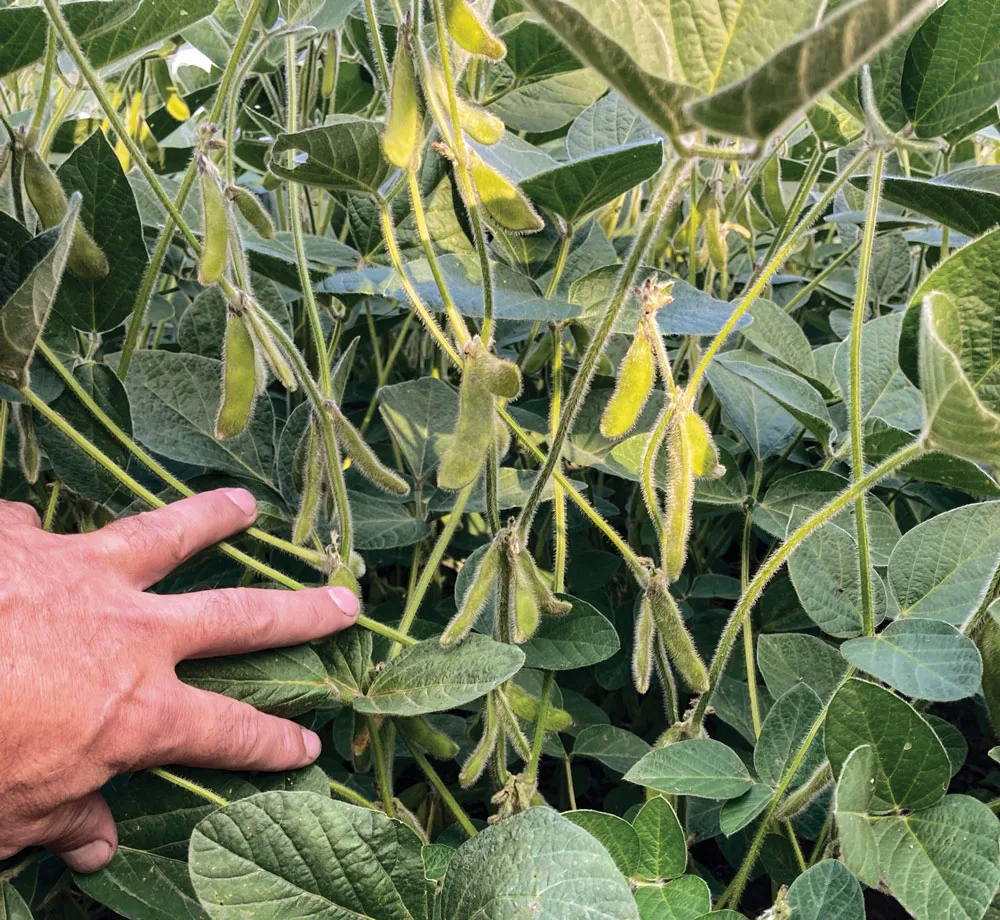
Meticulous management of a contest plot within an 11-acre field binned a record 115-bushel soybean yield for Brooklyn, Wis., strip-tiller Kevin Klahn and his Klondike Farms family in the 2025 Wisconsin Soybean Association Yield Contest.
Klahn credits the yield success to an overall team mentality focused on pushing the envelope of productivity and what he describes as a convergence of years of soil analysis and benefits he’s realizing from using soil biologicals.
“My wife, Erika, and I farm with our two older children, Abigail and Montana (Tanner),” Klahn says. “Erika does most of the bookwork, Abigail manages administrative and data-focused tasks as well as landlord engagements, while Tanner concentrates on farm operations and his wife, Haley, is instrumental in the farm’s accounting.”
Klahn includes the half dozen “under-30” employees in his team, noting their dependability and “contagious enthusiasm” for the farm’s success.
“Over the years we’ve also developed a team of businesses which have become part of our team, sharing the same goals,” he says.
My High-Yielding Soybeans

Yield: 115.54 bushels per acre
Planting Population: 165,000
Hybrid: Pioneer 28Z30E
Soil Type: Sandy loam
Planting Date: April 17
Harvest Date: October 2
Fertility: Potash, sulfur, 0-46-0, NEXTA biologicals, micronutrients
Crop Protection: Ilevo, Lumaderm, Envive, Tricor, Anthem Maxx, Shepherd, glyphosate, glufosinate
“I’d start with our banker at the top of the list,” Klahn adds. “Considering the tight margins, expensive equipment and high rents we face, her guidance has been invaluable.”
He also cites collaboration with his local Pioneer seed dealer, Klitzman Seed, and Pioneer agronomist Scott Roundtree, John Deere dealer Sloan Equipment, as well as his local ALCIVIA Cooperative for vital relationships that bear directly on success at Klondike Farms.
Strip-Till Strategies
Each year the Klahns rotate on-farm yield, product and management tests through 4 adjacent 11-acre plots. Three are in corn and one is in soybeans allowing a 3-year set of strip-tilled corn production ahead of soybeans put in the fourth year behind a vertical tillage pass.
Klahn strip-tills about 5,000 acres of corn with his 16-row Kuhn Krause Gladiator and custom strip-tills another 3,000 acres in the area. He would also strip-till his soybeans if he could.
“If I could strip-till every crop on my farm, I would,” Klahn says. “I’m envious of a neighbor who’s able to strip-till all his crops. We’re currently only strip-tilling corn. The only reason we don’t strip-till soybeans is because we’re planting them in 15-inch rows, while our corn is in 30-inch rows.”
Fall strip-till has proven to work best for Klahn, but he managed to strip-till about 1,500 acres this past spring because of time constraints after harvest.
“By using these products, it’s like we can give the plant an ibuprofen and make it feel like it’s not being stressed…”
“We prefer making strips in the fall because we just like how that mellows things out and the planting conditions are as good or better in that strip in the spring than they are in anybody’s fully tilled ground,” he says.
Klahn typically applies 200 pounds of potash with the Gladiator in the fall and waits until spring to split apply nitrogen (N) throughout the growing season.
“We used to apply anhydrous, but I didn’t like having all that nitrogen sitting out there through the winter,” Klahn says. “Between worries of losing nitrogen, the stabilizer costs and safety for my guys, we just went away from it.”
Klahn believes there’s a direct correlation between his record-breaking soybean crop and the 3 years of strip-tilled corn that preceded it.
“It seems like there’s some benefit to that banded fertilizer from the 3 years before, and the soybean roots being able to reach it,” Klahn says. “It just seems to benefit the soybeans in the same way it benefits corn, having that fertility available, especially later in the season.”
Deep Data Dive
To support observations with numbers, Klahn’s team keeps meticulous records and uses them to guide key decisions on inputs.
“I’ve been keeping farm records for a lifetime but just in the past few years it finally feels like we’re able to use that data and put it to work for us,” Klahn says. “This has provided the horsepower for the recent growth of our productivity.”
Data management at Klondike Farms is centralized through the John Deere Operations Center.
The farm’s soils are sampled on 2.5-acre grids every 4 years and assayed through Midwest Laboratory’s Ft. Atkinson facilities.
“We’ve undergone a philosophical shift in nutrient management, moving past fertilizer company-driven regimens that simply dictate applying set amounts of P and K,” he says. “Now, with the biologicals we’re seeing significant yield advances, moving 2 to 3 years upwards of our predicted curve last year — despite not necessarily fertilizing P and K or nitrogen for that massive jump.”
Klahn admits he was skeptical about biologicals at first but eventually became a strong believer after seeing how well they worked on his 44-acre experimental field.
“For the first time in my career it’s starting to make sense; understanding specifically what the plant is looking for and when, and how we can meet those needs at a specific time,” Klahn says. “I’m really impressed with some of the Corteva NEXTA products. If the plant is entering a stressful period, by using these products, it’s like we can give it an ibuprofen and make it feel like it’s not being stressed and likely get through the period without reducing yields.”
High Yield Recipe
A decade of custom work and on-farm experimentation has led Klahn to believe that earlier planted soybeans have much higher yield potential. The record-breaking plot went into the ground April 17, one of the first planting days of the season.
Like most of the soybeans produced by Klondike Farms, the 11-acre test field containing the yield-winning contest entry was planted into corn stubble treated with a single vertical tillage pass.
Pioneer’s 2.8 maturity 28Z30E variety carrying a full rate of Ilevo fungicide, Lumaderm and an inoculant was seeded with a 60-foot John Deere DB planter set on 15-inch rows. Klahn uses that planter on the bulk of his soybean acres.

SUCCESSFUL STRIPS. Klahn uses his 16-row Kuhn Krause Gladiator to make strips in the fall ahead of corn. Kevin Klahn
“Because the plan was to go heavy on fungicide and fertility, our planting population was set lower, at 165,000 seeds per acre,” Klahn says. “Pre-plant fertility, applied in the fall of 2024 included 200 pounds of potash and 100 pounds of 0-46-0 and sulfur.”
Following a pre-emergence herbicide program of Envive, Tricor, Shepherd water conditioner and glyphosate, the plot also got weeding assistance from post-emergence applications of glufosinate and Anthem Maxx.
Throughout the season the plot received further intensive management including several drone applications of the NEXTA products.
“The production fields normally receive NEXTA products and a full seed treatment, but the contest plot received an additional, more expensive program” Klahn says. “Specifically, we used a second application of fungicide and some micronutrients in the late season not used on the production fields.”
Integrated Approach
The proof of the performance came October 2, when Klahn got an urgent call from his employee requesting another truck or grain cart as the 11-acre soybean test field was being combined.
“We’re not going to be able to fit it all in a truck!,” Klahn recalls hearing the combine driver exclaim. “That was my first inkling we were truly onto something pretty decent.”
Even with the perimeter of the soybean plot surrounded by corn, which was competitively shading the outside bean rows, the entire soybean planting averaged more than 100 bushels per acre, with the contest plot itself binning 15% more.
Klahn says the pursuit of the farm’s high yields is deeply tied to the satisfaction of being productive and being part of the production cycle.
The yield bumps extend beyond the contest-winning soybean plot with corn yields also jumping from a high of 219 bushels per acre on the farm’s shallow sandy-loam fields in 2024, to 244 bushels per acre in 2025.
“We’re careful to credit timely, generous moisture to 2025’s harvests, but there’s more to the uptick we’re seeing than just moisture,” Klahn adds. “I think we’re seeing a tipping point to a better scientific understanding of the need to provide crop nutrients in a readily available form to the plant.
“When we couple that in an integrated approach leveraging advanced agronomy, precise data management, and a dedicated team, we can begin collecting unprecedented production dividends, even on challenging Wisconsin soils.”