Beaver Dam, Wis., strip-tiller Ryan Nell believes that moving up soybean planting dates is the key to unlocking higher yields.
Nell’s equipment arsenal includes two John Deere 1770NT planters. His 24-row planter has the Dawn Reflex down pressure system, while his 12-row uses Precision Planting’s AirForce. Both have 3-inch gauge wheels and use one Martin-Till spike and one rubber closing wheel. To combat severe white mold pressure, Nell uses VRT planting with populations ranging from 65,000-120,000 seeds per acre.
The sixth-generation farmer has been making strips in the fall across his 2,200 acres since 2015. Pairing AutoPath implement guidance with his strip-till system has been a “game changer.” Nell runs a Dawn Equipment 24-row BDO single bin strip-till bar which he uses each fall preceding soybeans to apply phosphorous (P), potassium (K), sulfur, calcium, zinc and boron.
In 2021, Nell started growing cereal rye and used an air seeder to plant it directly behind the combine and RowMax rolls with stalk stompers. He seeds the rye 1 inch deep at 35-50 pounds per acre and has seen significant weed reduction in soybeans. Other noticeable benefits include an increase in water infiltration rates, faster residue decomposition in the spring and white mold suppression.
Ten-Year Journey
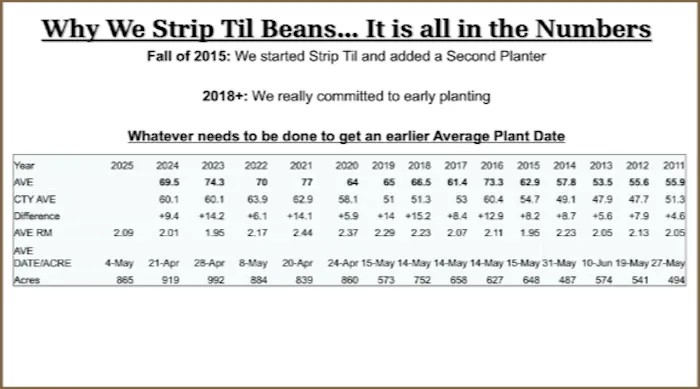
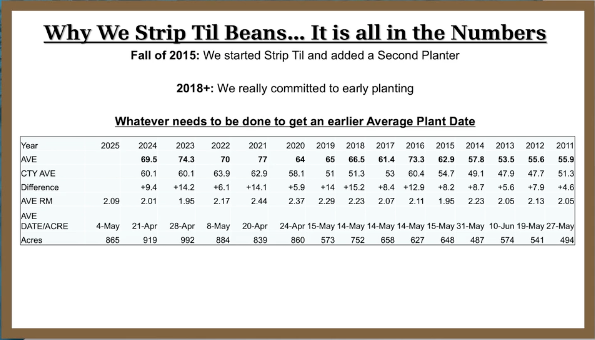
The implementation of strip-till and the addition of a second planter has allowed Nell to move his average soybean planting date up nearly two weeks across the past decade. Yields have steadily improved since then. In 2014, Nell averaged 57.8 bushels per acre while in 2024 he averaged 69.5.
This journey to plant earlier began in 2018 after some soybeans planted at 1.5-2.25 inches deep on March 23 received 16 inches of snow in mid-April.
“I was very nervous to see if they were going to survive,” Nell says. “We had really no issues with the stand whatsoever.”
After that success, Nell replicated the trial several more times. In 2019, the April 1 planted, 2.9 maturity soybeans yielded 84 bushels and were harvested before a 2.0 maturity variety that Nell planted on June 1. The earlier planted soybeans yielded about 25 bushels better.
In 2020, Nell planted on March 27 and those soybeans also yielded 84 bushels. In 2021, he moved planting up to March 22, and saw the yield jump to 89 bushels. Planting that early does require about a month of patience though, he says.
“We don't see the beans until between May 3 and May 5 when they finally come out of the ground,” Nell says.
“Am I planting every acre in March? No. It's spreading the risk out,” Nell says. “Every year I get nervous when I plant that much that early, and every year I kick myself, ‘Should have planted more, should have planted more, should have planted more.’”
‘Crazy Early’
This mentality led Nell to do what many people consider “crazy.” He planted 4 acres of soybeans on December 10, 2020 with the goal of a harvestable stand. Nell strip-tilled the beans into corn silage ground at three different depths. The trial ended in disappointment.
“We had a hard 2-inch crust at the end of April,” Nell says. “None of them made it. And that was even with cereal rye. We had a nice stand of cereal rye. None of the beans made it.”
Nell’s experiments didn’t end there. On March 3, 2024, he planted 11 acres at populations of 80,000, 100,000 and 120,000 at 2-2.5 inches deep. The beans emerged on April 29 and averaged 76 bushels per acre.
Once again, in 2025, Nell tested out planting “crazy” early. On January 31, 2025, the driest January on record in the Beaver Dam area, Nell planted 3 acres at 140,000. Where the ground had been strip-tilled there was no frost in the top 2-3 inches, but outside of the strip there was still frost in the ground.
“We planted 2-inches deep,” Nell says. “We were able to maintain 100% ground contact with the down force. I did slow down a little bit. There were obviously areas that were probably a little more frozen than I anticipated.”
Based on how close the December planted beans were to surviving, Nell thought the January ones were going to make it. When he checked on the seeds on March 14, they had started growing and looked good.
“The problem we ran into was it did not really freeze or get cold again,” Nell says. “We basically hung out about 40 degrees, damp, not wet by any means. I looked again in April and you couldn't even find the beans anymore.”
With these trials Nell isn’t advocating for farmers to go out and plant the entire farm as soon as there is a nice day, but the experience has shifted his mindset moving forward.
“It gives me confidence knowing the first part of April in Beaver Dam, Wisconsin, two planters are going to roll if conditions are fit,” Nell says. “If conditions are not fit, don't plant.”