TAKEAWAYS
- Tall, blackened berms might not be what you want after all.
- Less aggressive strip-till knives produce more ideal root zone soil conditions.
- Mole knives and gopher knives are aptly named, but that might not be a good thing.
Rex Bland believes in following the narrow path when it comes to strip-tilling.
Bland is owner and manager of Wako, LLC, a long-time north-central Oklahoma farm equipment manufacturer specializing in fertilizer and tillage equipment. Over the past 25 years, Wako strip-till units have been sold from Texas to North Dakota and remain available on demand.
While it’s been several years since that last Big Country Wagon strip-till rig left the shop the BCW strippers have a dedicated following because of lessons Bland learned during the engineering phase of his machines. BCW strippers feature a pair of coulters running abreast ahead of a narrow strip-till knife set at a 15-degree angle rather than the common 35-degree angle of most stripping row units.
“What we learned in the field can help strip-tillers regardless of the color of their toolbars and row units,” Bland says. “In most cases, we’re talking about the dimensions and design of the knives involved in berm building, and in most cases narrower is better than wider.”
The veteran iron bender also says being able to independently adjust strip-till coulters and knives for depth can make a big difference in preparing a strip that’s “yoked equally” to a grower’s planter.
“I use the biblical reference of being equally yoked because of my work with Kevin Kimberley who says, ‘Success with strip-till depends upon the marriage of the strip-till unit and the planter. If the strip isn’t right and the planter won’t plant right, you’ll have a divorce,’ something we kept in mind in the design of the Big Country Wagon series we produced,” Bland says.
Kimberley owns and operates Kimberley Ag Consulting in Maxwell, Iowa, and consults with strip-tillers, no-tillers and full-tillage growers across the Great Plains and the Corn Belt tweaking tillage/planting systems for improved profits and productivity.
Tunnel Vision
Bland is convinced the knives most strip-tillers are using are too wide to provide the optimum soil aggregate size for the most successful planting and crop emergence.
“I’m particularly skeptical of folks who proudly say they are building berms 5-to-8 inches tall,” he says. “If you have a berm that tall, you need to ask where did the soil come from to build it?
“That berm is standing up because the wide knife and its 35-degree angle lifted the soil so much it turned the potential root zone into an environment of clods surrounded by air pockets.”
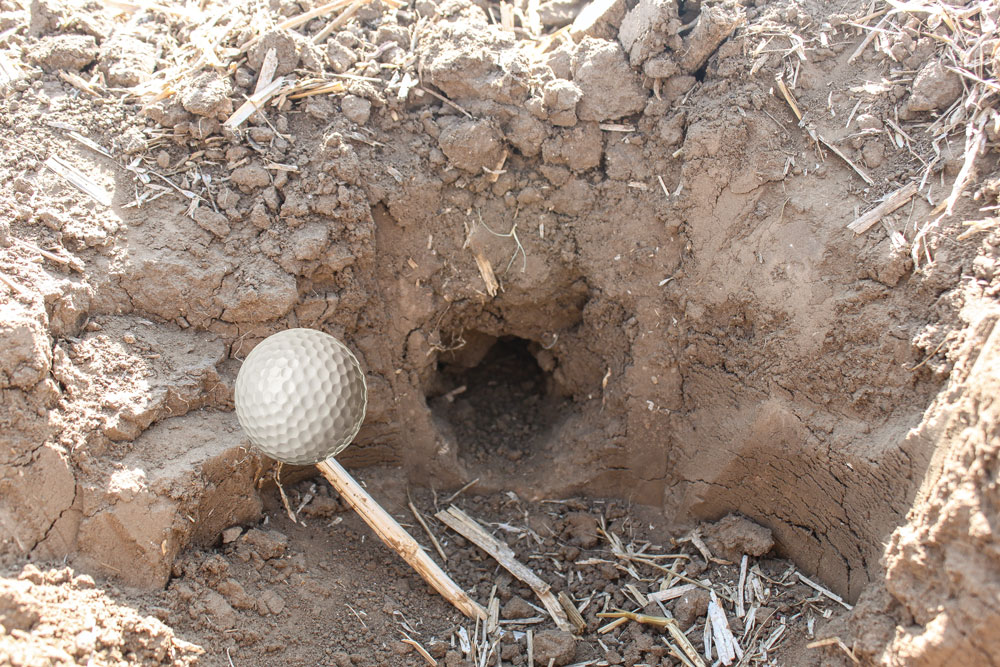
LONG TUNNEL. Rex Bland says running a typical 2-inch knife designed with a 35-degree lift angle invariably leaves a golf-ball-size tunnel at the bottom of the strip. When seed is planted 2-3 inches above the cavity, its roots encounter the top of the tunnel and self prune or grow laterally. If heavy rains occur after planting, the seed can settle several inches into the collapsed tunnel. Rex Bland
He also says in most cases the high-angle knife with a 2-inch-wide foot will leave a golf-ball-size tunnel directly under the planting zone.
“The seed is planted only a couple of inches above that cavity and as the roots reach the roof of that tunnel they either self-prune or grow horizontally to remain in contact with the soil — essentially as if they had hit a compaction layer.”
“Mole knives and gopher knives are aptly named,” Bland says. “Moles and gophers leave tunnels, just as the tools’ names suggest.”
NARROW KNIFE KERF. A strip-till row unit with a knife of about 0.5-inch width, set at 15 degrees leaves a friable root zone and reduces the “tunneling” of traditional knives to about the diameter of a No. 2 wooden pencil. Rex Bland
Bland says when rains occur, such tunnels eventually cave in, and if the seed is located directly above the tunnel when it collapses, the seed will be drawn downward, severely changing the effective planting depth and spoiling the desired picket-fence stand.
“During our testing on an 80-acre field near our shop in north-Enid, we tried all different kinds of coulters and knives from various suppliers as well as our own, and invariably we found the wide-foot knives (over 1/2 inch) left clods, and underneath we found the tunnels.
“I used a sewer snake on those treatments and could run 50 feet up the rows stripped with gopher and mole knives and high-lift 2-inch knife feet and never touch anything,” Bland recalls. It wasn’t until he did some “constructive grinding” on his own commercially-available knives — down to 0.5-inch wide — that he reduced the tunnel diameter to the size of a wooden pencil.
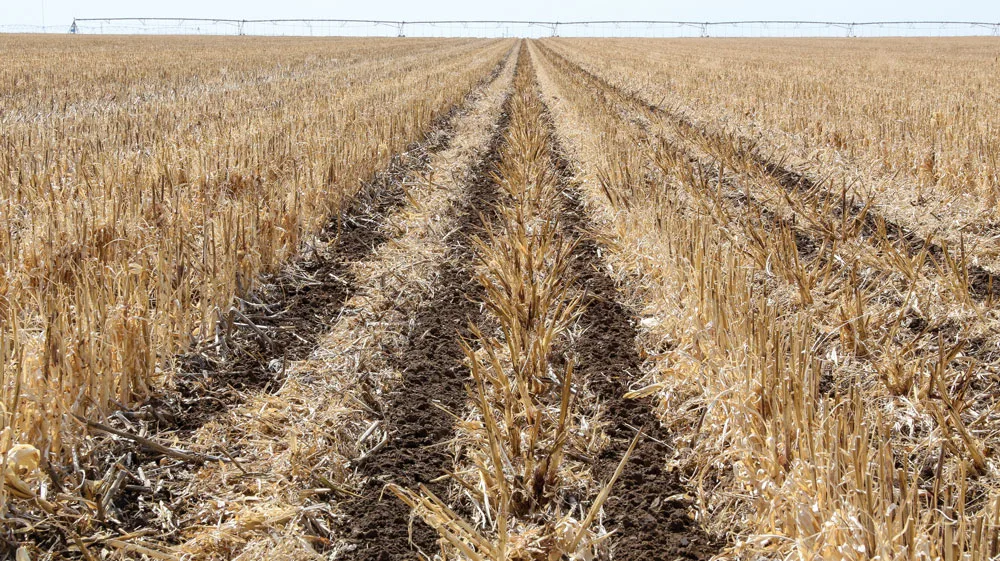
“Kevin also convinced me to reduce the angle of the blades we were modifying to eliminate the severe lifting that essentially fractures the soil into clods and invites blowouts,” Bland says. “That’s how we finally developed our MT50 knife running in the middle, behind a set of parallel coulters set 6-to-8 inches apart. With that setup we found the soil would move around the sharpened knife-shank instead of boiling up into a tall berm of clods and air pockets. The 15-degree angle of the shank ended with a 0.75-inch foot at the bottom running only 5 degrees lift.”
The result was a nearly level strip of friable soil 5 to 10 inches wide and ready for planting.
“When you can produce aggregates the size of BBs in the strip, you’ll eliminate most of the air pockets, which will ultimately improve germination and stand count,” Bland says.
Working Depth Adjustments
Beyond adopting less aggressive knife angles, Bland suggests strip-tillers using traditional rolling cutter-and-knife row units adjust the depth of the coulter to match the depth of knife as closely as possible to further prevent heaving of soil.
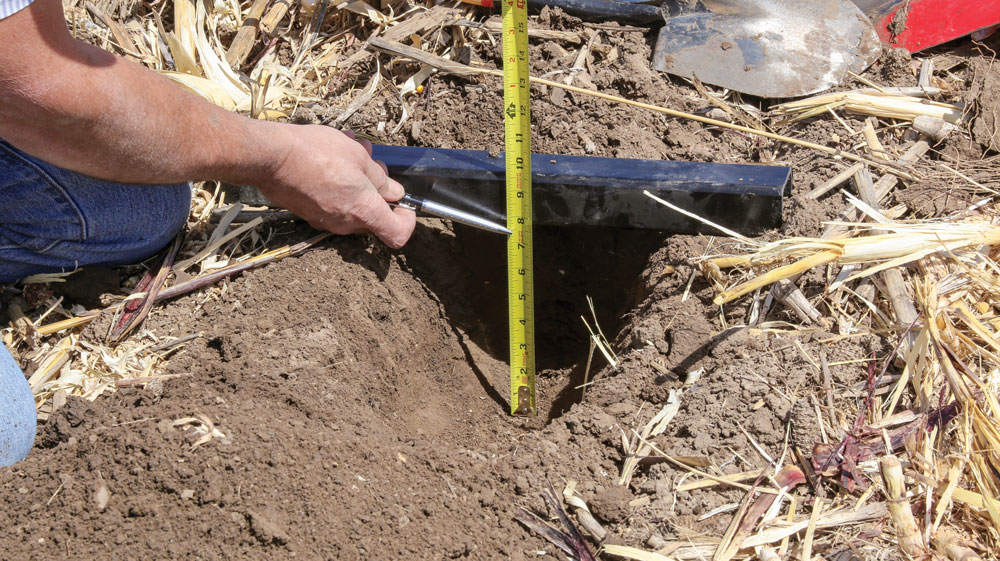
MEASURING TECHNIQUE. Much like in-field inspections behind a planter, Bland says spending time with a tape measure and a pair of spades behind a strip-till rig can point out shortcomings of many of today’s most popular strip-till knives. He recommends matching and adjusting various coulters to less-aggressive knives for best berm performance. Rex Bland
“They need to be running that coulter as deep as they run the knife to provide a path for the knife,” he says. “If you’re only running the coulter deep enough to cut residue and then follow with a high-angle knife running much deeper, the result will be too much lift of the soil which leaves the large aggregate sizes.”
He says cutting a path ahead of the knife at working depth reduces the effects of kinetic energy on the soil in the strip.
Embrace Needed Change
While Bland is no longer actively advertising strip-till machines, he’s a believer in the practice, and says many growers aren’t receiving the most benefits from strip-till because they aren’t willing to experiment and change knives and coulters to avoid the tunneling and large aggregates their tools are producing.
“It takes work to change all the ground-engaging components on a strip-till bar,” Bland says. “For too many growers, it’s just easier to drop it in the ground with what they’ve been using and go with it.”
For those willing to up their game, however, Bland recommends digging behind their current set-up to determine if they are leaving “gopher tunnels” under the planting zone, or boiling up cloddy aggregates.
“When you can produce aggregates the size of BBs in the strip, you’ll eliminate most of the air pockets, which will ultimately improve germination and stand count…”
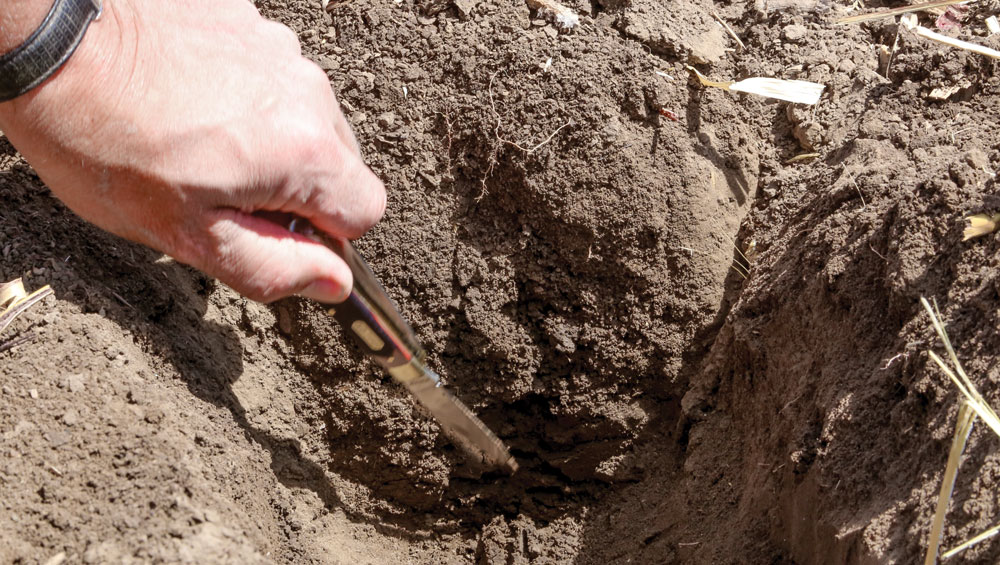
“Kevin taught me to shove a spade into the ground across the strip, then use another spade to dig out behind it all the way to the bottom of the strip. Try to go as deep as the knife is running,” Bland says. “Once the strip is clear behind the first spade, pull that spade out and look at the cross-section of the strip, from the soil surface to the bottom track of the knife.
“Use a pocket knife to chip away at the strip where the roots will be growing and check for aggregate size and signs of that hole in the bottom.”
Bland suggests changing the knife and coulter on a single row unit for the experiment and finding the right combination and adjustments (if applicable). Then, make the commitment to upgrade the entire width of the stripper.
“I’d just make the changes and go,” he says. “As long as you’re operating in the same soils you will have made significant improvements to your management without having to repeat the digging process over and over.”
Know What You’re Buying
As a final recommendation, Bland says strip-till is successful across many soil types and geographies, but there is no “one size fits all” strip-till row unit.
“That’s why it’s important to be able to mount different knives and coulters to any machine you’re considering buying,” he says. “Also, there are some popular strip-till rigs out there without adjustable coulters, and others that use only proprietary knives. Farmers need options and ensuring you will have options is much easier when you’re shopping than after you’ve written the check.”